Navigation at the Commercial Pilot Licence level represents a clear shift in how flight planning and execution are approached. While Private Pilot training focuses on the fundamentals of getting from point A to point B, CPL navigation demands a higher standard — the ability to plan, monitor, adjust, and justify each decision under real operational conditions. This means integrating weather information, managing fuel precisely, communicating effectively with air traffic control, and adapting to changing circumstances along the route. Transport Canada expects CPL candidates to demonstrate stronger decision-making and a deeper understanding of how different systems interact compared to the PPL level.
Who This Article Is For
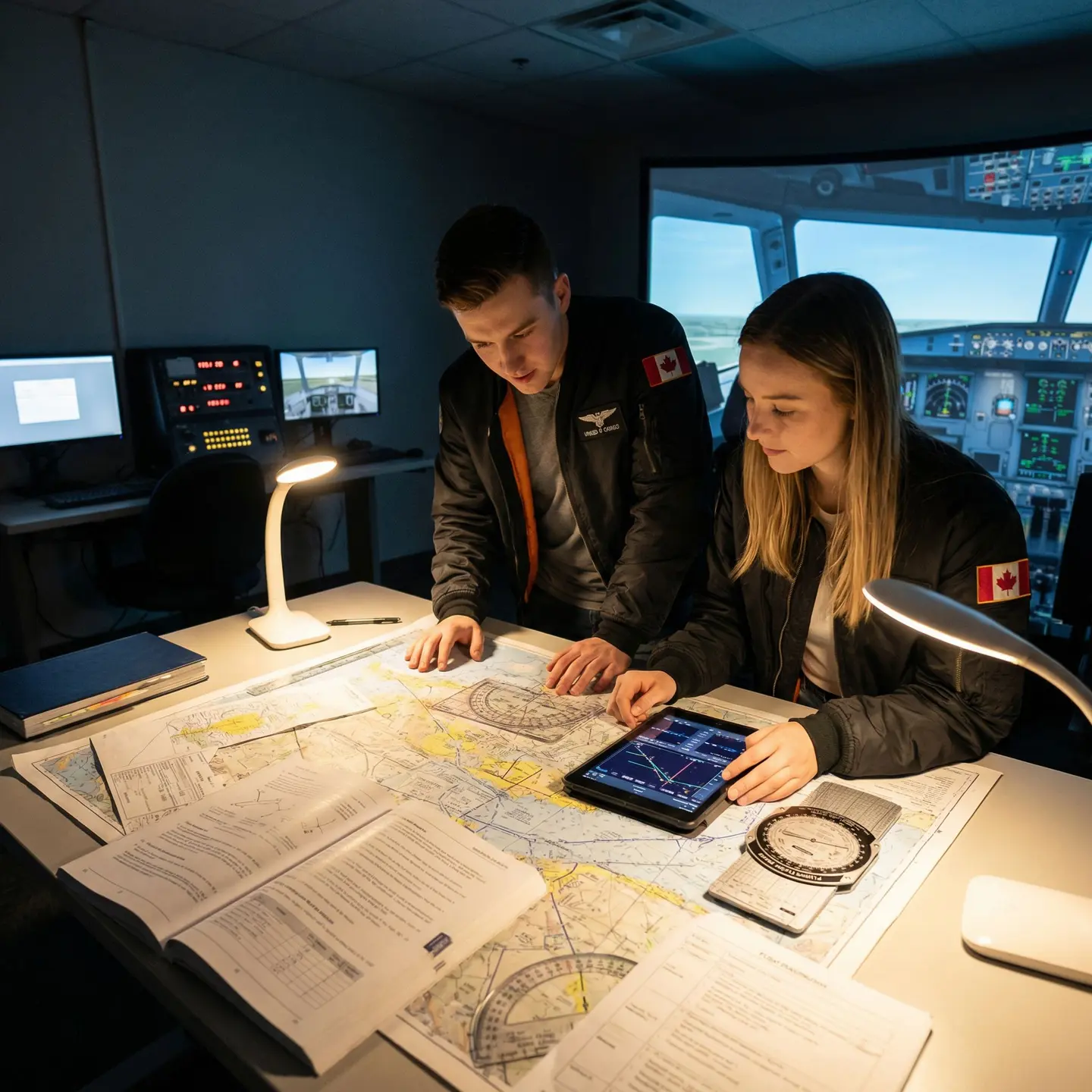
This article is written for Canadian student pilots actively preparing for the Commercial Pilot Licence written examination and flight test. If you are completing CPL ground school, transitioning from your PPL, or refreshing your navigation knowledge before an exam, this content is designed for you.
This article is not intended for readers who have not yet completed Private Pilot training. We assume familiarity with basic chart symbols, fundamental dead reckoning principles, and the general structure of VFR flight planning. If you need to revisit those foundations, we recommend starting with our CPL Ground School resources, which provide a structured pathway through all required subjects.
What TP 12881 Says About Navigation for the CPL Exam
The TP 12881 Commercial Pilot Licence – Aeroplane Study and Reference Guide establishes navigation as a mandatory examination subject. To pass the CPL written exam, candidates must achieve:
- A minimum of 60 percent in the Navigation section
- A minimum of 60 percent overall
Navigation questions at the CPL level are integrated into operational scenarios that require you to combine multiple knowledge areas—weather, fuel, airspace, and radio navigation—into coherent decision-making processes.
The exam expects you to demonstrate that you understand why certain decisions are correct, not simply that you can arrive at a numerical answer. This operational focus distinguishes CPL navigation from the more procedural approach tested at the PPL level.
Core Navigation Theory Beyond The Basics
CPL navigation builds upon PPL foundations but requires deeper understanding of the principles underlying every calculation. Let us examine the key theoretical areas where Transport Canada expects enhanced competency.
Earth Geometry and Its Practical Applications
Understanding latitude and longitude relationships becomes operationally important when planning longer cross-country flights. At the CPL level, you must understand:
- Great circles versus rhumb lines: A great circle represents the shortest distance between two points on the Earth’s surface, while a rhumb line crosses all meridians at the same angle. For shorter flights, the difference is negligible. For longer routes, understanding when great circle routing saves fuel and time becomes relevant.
- Track versus heading versus bearing: Track is your intended path over the ground. Heading is where the nose of the aircraft points. Bearing is the direction from one point to another. Wind creates the difference between track and heading. Confusing these terms leads to navigation errors.
How the Wind Affects Your Navigation
Navigation requires you to work with forecast winds that may differ from actual conditions and adjust your flight plan accordingly:
- Using winds aloft forecasts (FBs) to calculate planned groundspeed and heading
- Detecting when actual groundspeed differs significantly from planned values
- Recalculating ETAs and fuel burn when wind conditions change
- Understanding how temperature variations at altitude affect true airspeed calculations
Airspeed Conversions and Air Density Effects
Converting between indicated airspeed (IAS), calibrated airspeed (CAS), and true airspeed (TAS) is essential for accurate navigation planning. Air density decreases with altitude and increases with temperature, affecting TAS calculations. At the CPL level, you must understand:
- Why IAS differs from TAS at altitude
- How to apply density altitude corrections to navigation calculations
- The relationship between pressure altitude, temperature, and true airspeed
These conversions directly affect groundspeed calculations, fuel planning, and ETA accuracy.
Chart Interpretation for Operational Navigation
CPL pilots must demonstrate proficiency with chart types that extend beyond VFR navigation charts. While you may not fly IFR routes during initial CPL operations, understanding IFR chart products is essential for situational awareness and future progression.
Canadian IFR Chart Products
NAV CANADA publishes several chart types that CPL pilots should understand:
- Enroute Low Altitude Charts: Cover airways from the surface to 18,000 feet ASL. These charts depict victor airways, minimum enroute altitudes (MEAs), navigation aids, and reporting points.
- Enroute High Altitude Charts: Cover jet routes above 18,000 feet in the Southern Domestic Airspace and above FL230 in the Northern Domestic Airspace.
- Terminal Area Charts (TACs): Provide detailed information for navigation within congested terminal areas, showing approach facilities, holding patterns, and transition routes.
These charts provide information not depicted on VFR charts, including minimum obstacle clearance altitudes, established airways, mandatory reporting points, and additional data required for IFR operations.
The Canada Flight Supplement
The Canada Flight Supplement (CFS) is an essential planning document for every cross-country flight. CPL pilots use it to obtain:
- Aerodrome data including runway lengths, lighting, and services
- Radio frequencies for navigation aids, communications, and weather services
- Procedure codes and operational notes affecting route planning
- Special procedures for specific aerodromes
Route selection, alternate airport identification, and fuel planning all depend on accurate CFS interpretation.
Pre-Flight Advanced Planning: Risk and Compliance Focus
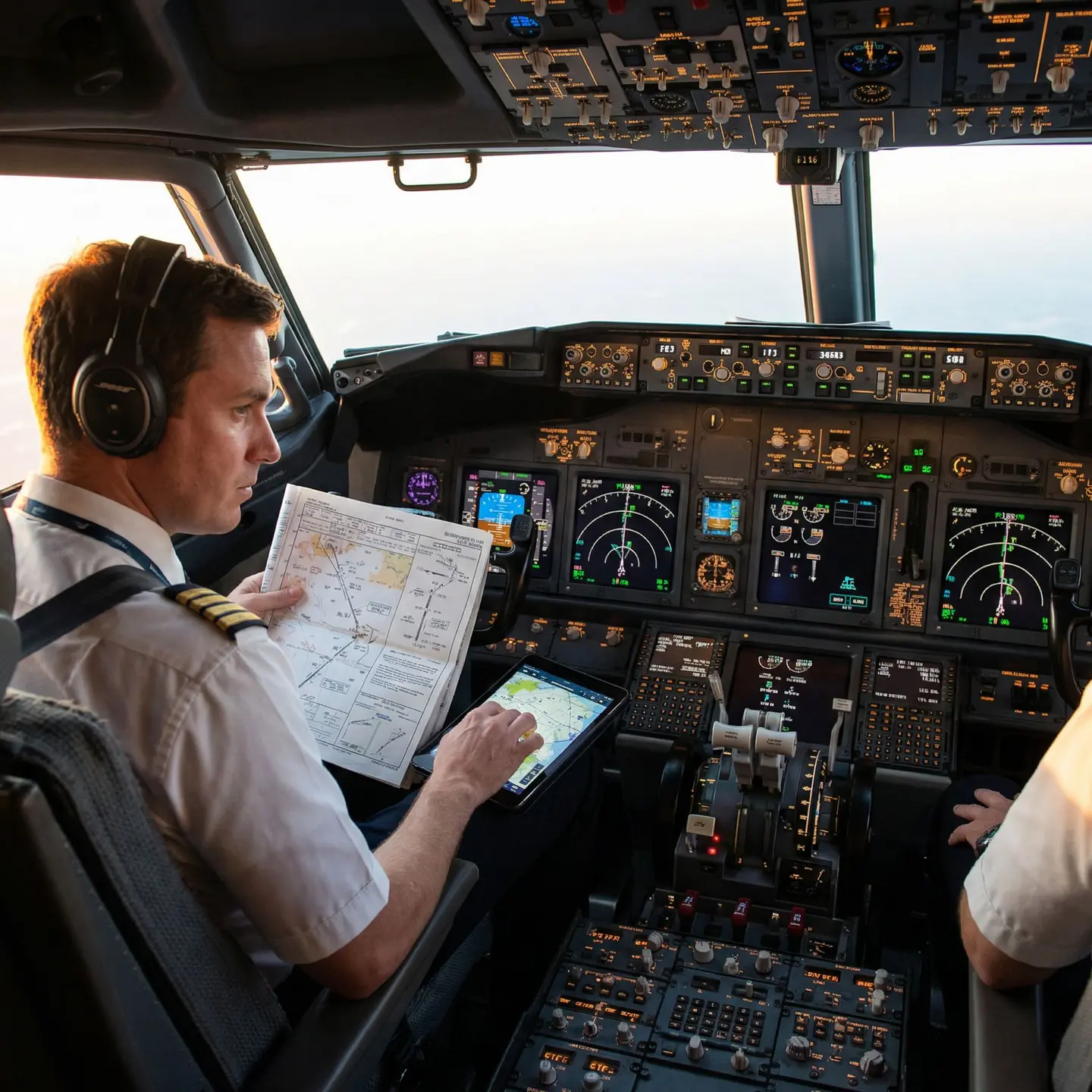
Advanced navigation planning goes beyond drawing lines on charts. It requires systematic risk assessment and regulatory compliance verification before every flight.
Risk-Based Route Selection
CPL pilots must evaluate multiple factors when selecting a route:
- Terrain considerations: Identifying high terrain along the route, determining minimum safe altitudes, and planning for engine-out glide capability
- Weather forecast impacts: Assessing ceiling and visibility forecasts, identifying areas of potential turbulence or icing, and planning routes that avoid forecast hazards
- Alternate planning: Identifying suitable alternates along the route, calculating fuel required to reach alternates, and verifying alternate aerodrome suitability
Fuel Management
Fuel planning is inseparable from navigation planning. Pilots must account for:
- Trip fuel based on planned groundspeeds
- Required reserves as specified in the Canadian Aviation Regulations
- Contingency fuel for potential diversions or holding
- Additional fuel when weather conditions create uncertainty
Fuel management is not a separate checklist item—it is integrated throughout the navigation planning process. Every route change, every ETA revision, and every diversion decision has fuel implications that must be calculated and verified.
NOTAM and AIP Supplement Review
NOTAMs and AIP Supplements contain critical information affecting route legality and safety:
- Navigation aid outages that may require alternate routing
- Temporary flight restrictions or airspace changes
- Runway closures affecting alternate airport selection
- Procedure changes that affect planned approaches
At the CPL level, NOTAM review is not a final box to tick; it is a critical part of structured pre-flight planning and sound operational decision-making.
Radio Navigation Tools Beyond Basic Operation
CPL navigation requires operational proficiency with radio navigation systems, understanding not just how to tune them but how to integrate them into a complete navigation solution.
VOR Navigation
At the CPL level, VOR proficiency includes:
- Interception: Calculating intercept angles to join a specific radial efficiently
- Tracking: Maintaining course with appropriate wind corrections
- Cross-radial fixes: Using two VOR stations to establish a precise geographic position
- Understanding limitations: Recognizing line-of-sight restrictions, station interference, and accuracy variations
ADF and NDB Interpretation
While NDB facilities are declining in number, understanding ADF operation remains relevant:
- Relative bearing interpretation and conversion to magnetic bearing
- Tracking to and from NDB stations with wind correction
- Recognizing ADF limitations including night effect, shoreline effect, and thunderstorm interference
GNSS and DME Integration
Modern navigation increasingly relies on GNSS (Global Navigation Satellite System), but CPL pilots must understand:
- How GNSS integrates with conventional navigation planning
- The importance of cross-checking GNSS positions with other sources
- DME as a backup distance reference when GNSS is unavailable or unreliable
- RAIM (Receiver Autonomous Integrity Monitoring) requirements and limitations
Transponder and Radar Awareness
Each radio navigation tool contributes to a redundant navigation system. CPL pilots must understand how to use multiple tools together, cross-checking each against the others to detect and correct errors.
In-Flight Navigation Management: Monitoring and Correction
Managing a flight in progress requires continuous monitoring, early recognition of developing errors, and timely, systematic correction to keep the operation safe and precise.
Position Fixing
Accurate position fixing requires multiple data sources:
- Visual checkpoints correlated with planned positions
- Radio fixes using VOR cross-radials or ADF bearings
- DME arcs or distances from known stations
- GNSS position verified against other references
Single-source positions are estimates. Multiple-source positions are fixes. CPL pilots must distinguish between the two and use appropriate techniques for each situation.
The 1-in-60 Rule for Error Assessment
The 1-in-60 rule provides a rapid method for calculating track errors and corrections:
- One degree of track error results in approximately one nautical mile deviation per 60 nautical miles flown
- This relationship works in both directions: knowing distance off track and distance flown, you can calculate track error in degrees
- The rule enables rapid mental calculations without requiring a navigation computer
Groundspeed and ETA Monitoring
Continuous groundspeed monitoring allows early detection of significant deviations:
- Calculate groundspeed at each checkpoint using time and distance
- Compare actual groundspeed to planned groundspeed
- Revise ETAs when groundspeed differs by more than 5 percent
- Recalculate fuel burn when groundspeed changes affect flight time significantly
Drift Determination and Heading Correction
When track deviation is detected:
- Determine the amount of drift using visual references or radio fixes
- Calculate the correction needed to parallel the intended track
- Apply additional correction to regain track if required
- Verify the correction is working at the next checkpoint
Double-Track Error Method
When you have drifted off track, the double-track error method provides a systematic recovery:
- Calculate your track error in degrees
- Apply double the track error initially to intercept the original track
- Once on track, reduce correction to the single track error amount to maintain track
This method is only effective when applied before reaching the halfway point of the leg, allowing you to regain track efficiently and re-establish accurate navigation early.
Diversions and Lost Procedures
Diversion decisions require rapid integration of multiple factors:
- Why is diversion necessary? Weather, mechanical, fuel, or passenger emergency?
- What alternate is most suitable considering runway length, services, and fuel required?
- What is the new heading, distance, and time to the alternate?
- Is fuel sufficient with required reserves?
Lost procedures follow a specific sequence: maintain aircraft control, check last known position, verify heading and time, attempt to identify position using visual or radio fixes, and if position cannot be established, consider climbing for better visibility or communication, or contacting ATC for assistance.
Decision traps include fixating on the original destination, delaying diversion until fuel becomes critical, or becoming so focused on navigation that aircraft control suffers.
Integration with Weather, Airspace, and Systems
Advanced navigation cannot be practiced in isolation. Every navigation decision connects to weather conditions, airspace structure, and aircraft systems.
Weather Effects on Navigation Decisions
Weather directly affects navigation planning:
- Wind forecast integration: Upper wind forecasts (FBs) provide planning data, but actual winds may differ. Monitor groundspeed continuously to detect significant variations.
- Visibility impacts on route planning: Reduced visibility may require routing around weather or selecting routes with better visual references.
- Ceiling considerations: Low ceilings affect minimum enroute altitudes and may require IFR routing even for VFR-rated pilots transitioning to IFR.
Airspace Structure and Navigation Expectations
Navigation within controlled airspace requires different procedures than uncontrolled airspace:
- Specific routing requirements when transiting Class C or D airspace
- Altitude restrictions and mandatory reporting points
- Communication requirements that affect navigation monitoring time
- Transponder requirements for position reporting
The TC AIM (TP 14371) provides detailed guidance on airspace procedures that affect navigation planning.
System Redundancy and Cross-Checking
Relying on a single navigation source creates vulnerability to undetected errors:
- Use GNSS, VOR, and visual references together when possible
- Cross-check positions from different sources
- Recognize when sources disagree and determine which is reliable
- Maintain proficiency with manual navigation techniques as backup
Common Exam Format and Test Focus

Navigation questions on the CPL written examination reflect the operational focus described throughout this article. Questions are:
- Scenario-based: You will be given a situation and asked to make decisions, not simply perform calculations
- Integrated: Questions may combine navigation with weather, fuel, or airspace considerations
- Operationally justified: Correct answers require understanding why a procedure is appropriate, not just memorizing steps
Sample test behaviors include:
- Multi-step calculations where an error in one step affects subsequent answers
- Questions requiring risk assessment embedded in the navigation decision
- Scenarios where the “textbook” answer must be modified for operational conditions
Preparing for these questions requires practicing with realistic scenarios, not just memorizing formulas. Our CPL Ground School provides practice questions designed to develop this integrated reasoning capability.
What Makes Advanced Navigation Different
Transport Canada’s expectations reflect the realities of commercial operations. At the CPL level, navigation competency isn’t simply about completing a cross-country flight. It’s about managing that flight professionally — monitoring continuously, correcting deviations promptly, and using all available information to make sound aeronautical decisions.
Advanced navigation for CPL pilots begins long before takeoff and continues throughout the flight. It involves structured planning, disciplined in-flight monitoring, timely corrections, and thoughtful system integration — all aligned with Canadian operational standards.
Frequently Asked Questions
How does CPL navigation differ from PPL navigation in terms of decision-making demands?
Navigation at the CPL level requires us to integrate every decision into an operational system—weather, fuel, ATC communications, and real-time adjustments. Transport Canada’s TP 12881 mandates 60% proficiency in navigation, emphasizing why decisions are sound, not just calculations. This addresses your pain point of feeling overwhelmed by exam scenarios; practice integrated planning to build confidence in justifying choices under pressure.
How do we handle in-flight deviations like track errors or diversions effectively?
For track errors, we apply the double-track error method: double the degrees off to intercept, then single to maintain—verified at next fix. Diversions demand rapid headings, fuel checks, and alternate suitability. Lost? Prioritize control, then fixes. These techniques counter the panic of disorientation; we simulate scenarios in ground school to ingrain calm corrections, using VOR cross-radials and GNSS cross-checks for redundancy, turning crises into confident recoveries.
Why integrate radio navigation like VOR and GNSS with visual methods for CPL?
We emphasize cross-checking VOR interceptions, ADF bearings, and GNSS with visuals—never single-source fixes—as CPL demands redundant systems per the TC AIM. Understand limitations like ADF night effect or RAIM. This eases the fear of undetected errors in busy airspace; by mastering multi-tool fixes and 1-in-60 mental math, we ensure precise positioning, meeting exam expectations for operational proficiency and safer flights in real conditions.