When you transition from studying for your Private Pilot Licence to preparing for your Commercial Pilot Licence, one of the most significant shifts you’ll encounter is in how you must approach meteorology. At the CPL level, that fundamental approach changes. You must predict what the weather will do, assess how those changes affect your operation, and integrate weather into every planning and dispatch decision you make. This operational meteorology mindset represents a core competency expected of commercial pilots, and it’s precisely why Transport Canada structures the CPL written examination to test your ability to forecast weather impacts, evaluate trend evolution, and make risk-based decisions that go far beyond basic weather recognition. If you’re preparing for your CPL Ground School, understanding these differences early will help you study with the right focus and develop the decision-making framework commercial operations demand.
Who This Article Is For
This article is written specifically for Canadian student pilots who have completed or are familiar with PPL-level meteorology and are now advancing toward their Commercial Pilot Licence. You should already understand basic weather concepts like cloud types, frontal systems, and how to decode a standard METAR, TAF or GFA.
This article is for you if:
- You’re enrolled in or preparing for CPL ground school
- You want to understand what additional meteorology knowledge Transport Canada expects at the commercial level
- You need to connect weather theory to operational flight planning and dispatch decisions
This article is not for you if:
- You’re just starting your aviation journey and haven’t yet studied PPL meteorology fundamentals
- You’re looking for basic definitions of weather phenomena
- You need exam-specific study strategies (that content belongs in a dedicated CPL study checklist)
Expanded Atmospheric Structure: Why It Matters Operationally
At the PPL level, we introduced you to the standard atmosphere and basic pressure-altitude relationships. At the CPL level, you must understand how deviations from standard conditions create operational consequences that affect your planning, performance calculations, and legal compliance.
Vertical Atmospheric Structure and Non-Standard Lapse Rates
The standard atmosphere assumes a temperature decrease of approximately 2°C per 1,000 feet up to the tropopause. However, actual atmospheric conditions rarely match this model. As a commercial pilot, you must recognize when environmental lapse rates differ from standard and understand what those differences mean:
- Steeper-than-standard lapse rates indicate unstable air with potential for convective activity, turbulence, and rapid weather changes
- Shallower lapse rates or inversions indicate stable air that traps pollutants and moisture, creating visibility restrictions and persistent fog conditions
Pressure Systems and Performance Impacts
Pressure gradients don’t just create wind—they directly affect your aircraft’s performance and the accuracy of your altimeter. Commercial operations require you to understand these relationships because they affect:
- Climb gradients: Lower pressure and higher temperature reduce air density, degrading climb performance. When planning departures from high-elevation airports or on hot days, you must calculate whether your aircraft can meet required obstacle clearance gradients.
- Terrain clearance: Flying from high to low pressure without proper altimeter corrections means your true altitude is lower than indicated—a critical consideration when planning routes over mountainous terrain.
- Density altitude calculations: CPL-level planning requires you to determine actual density altitude and apply it to takeoff distance, climb rate, and service ceiling calculations, not just recognize that “hot and high means poor performance.”
Transport Canada’s TP 12881 – CPL Study and Reference Guide explicitly requires commercial pilots to apply atmospheric knowledge to performance planning, making this operational integration a core exam competency.
Stability, Lapse Rates, and Vertical Motion Analysis
The distinction between PPL and CPL meteorology becomes especially clear when we examine stability concepts. At the PPL level, you learned to identify stable versus unstable air by observing cloud types and flight conditions. At the CPL level, you must predict where weather will form and how it will evolve.
Adiabatic Processes and Lifting Mechanisms
Understanding adiabatic lapse rates allows you to forecast cloud development and weather evolution:
- Dry adiabatic lapse rate (DALR): Approximately 3°C per 1,000 feet—the rate at which unsaturated air cools when lifted
- Saturated adiabatic lapse rate (SALR): Approximately 1.5°C per 1,000 feet—the rate at which saturated air cools when lifted (slower due to latent heat release)
By comparing environmental lapse rates to these adiabatic values, you can determine:
- Whether air parcels will continue rising (unstable) or resist vertical motion (stable)
- At what altitude clouds will form (lifting condensation level)
- How much vertical development to expect from convective clouds
Lifting Mechanisms and Their Operational Consequences
Commercial pilots must recognize the four primary lifting mechanisms and understand what each produces:
- Frontal lifting: Creates organized bands of weather along frontal boundaries with predictable movement and evolution
- Orographic lifting: Produces persistent cloud, precipitation, and turbulence on the windward side of terrain
- Convective lifting: Creates isolated to scattered cells with rapid development
- Convergence: Where air masses meet and are forced upward, often creating widespread weather over large areas
Each mechanism creates different hazards and requires different planning responses. Frontal weather moves predictably and can often be waited out. Orographic effects persist as long as wind direction remains constant. Convective activity follows diurnal patterns but individual cells are difficult to predict precisely.
Subsidence Inversions and Boundary Layer Effects
Subsidence occurs when air descends from upper levels, compressing and warming as it sinks. This creates strong temperature inversions that:
- Cap convective development, limiting cloud heights
- Trap moisture and pollutants below the inversion, degrading visibility
- Create turbulent boundary layers where aircraft transitioning through the inversion encounter abrupt condition changes
For commercial operations, recognizing subsidence inversions helps you predict visibility conditions, understand why conditions may remain poor despite forecast improvements, and anticipate where turbulence will occur during climb and descent.
Wind Behavior and Operational Risk
At the PPL level, you must understand how wind affects your flight—particularly its impact on crosswind limits, ground speed, and basic flight planning. At the CPL level, that same understanding is expanded further: you must also consider how wind varies with altitude, time, and terrain, and apply that knowledge to fuel planning, route selection, and altitude optimization.
Wind Forces and What They Mean Operationally
Three forces determine wind behavior:
- Pressure gradient force: Drives air from high to low pressure—the stronger the gradient (closer isobars), the stronger the wind
- Coriolis effect: Deflects wind to the right in the Northern Hemisphere, creating the familiar pattern of clockwise flow around highs and counter-clockwise flow around lows
- Friction: Slows surface wind and causes it to flow across isobars toward low pressure; above the friction layer (approximately 2,000-3,000 feet AGL), wind flows parallel to isobars
Veering and Backing Winds
In Canada, wind typically veers (shifts clockwise) with altitude as friction effects decrease. However, backing winds (counter-clockwise shift with altitude) indicate:
- Cold air advection occurring aloft
- Potential for approaching weather systems
- Possible destabilization of the atmosphere
Recognizing these patterns from upper wind charts and pilot reports helps you anticipate weather changes before they appear in surface observations.
Terrain-Induced Wind Effects
Canadian commercial operations frequently involve flight over or near mountainous terrain. You must understand:
- Mountain waves: Oscillating airflow downwind of ridges that can extend well above the peaks and produce severe turbulence and rapid altitude changes
- Valley winds: Diurnal patterns where air flows upslope during the day (anabatic) and downslope at night (katabatic)
- Funnel effects: Wind accelerating through passes and valleys, often exceeding speeds indicated by synoptic charts
Wind Shear: The Critical Hazard
Wind shear—a rapid change in wind speed or direction over a short distance—represents one of the most serious weather hazards for commercial operations. CPL-level understanding requires you to recognize:
- Where shear occurs: Near fronts, around thunderstorms, in low-level jets, and near terrain
- How shear affects aircraft: Sudden loss or gain of airspeed and lift during critical phases of flight
- How to identify shear risk: Through forecast products, PIREPs, and recognition of conducive meteorological conditions
Jet Stream Awareness
While jet stream flight planning becomes more critical at the ATPL level, CPL pilots must understand basic jet stream behavior:
- Location varies seasonally (further south in winter, weaker and further north in summer)
- Core winds can exceed 100 knots, significantly affecting groundspeed and fuel consumption
- Clear air turbulence often occurs near jet stream boundaries
- Temperature gradients along jet stream edges create density altitude variations
Advanced Clouds, Precipitation, and Turbulence Hazards
At the CPL level, understanding clouds shifts from identification to prediction. You must connect cloud types to their formation mechanisms and anticipate associated hazards.
Cloud Classification by Formation Mechanism
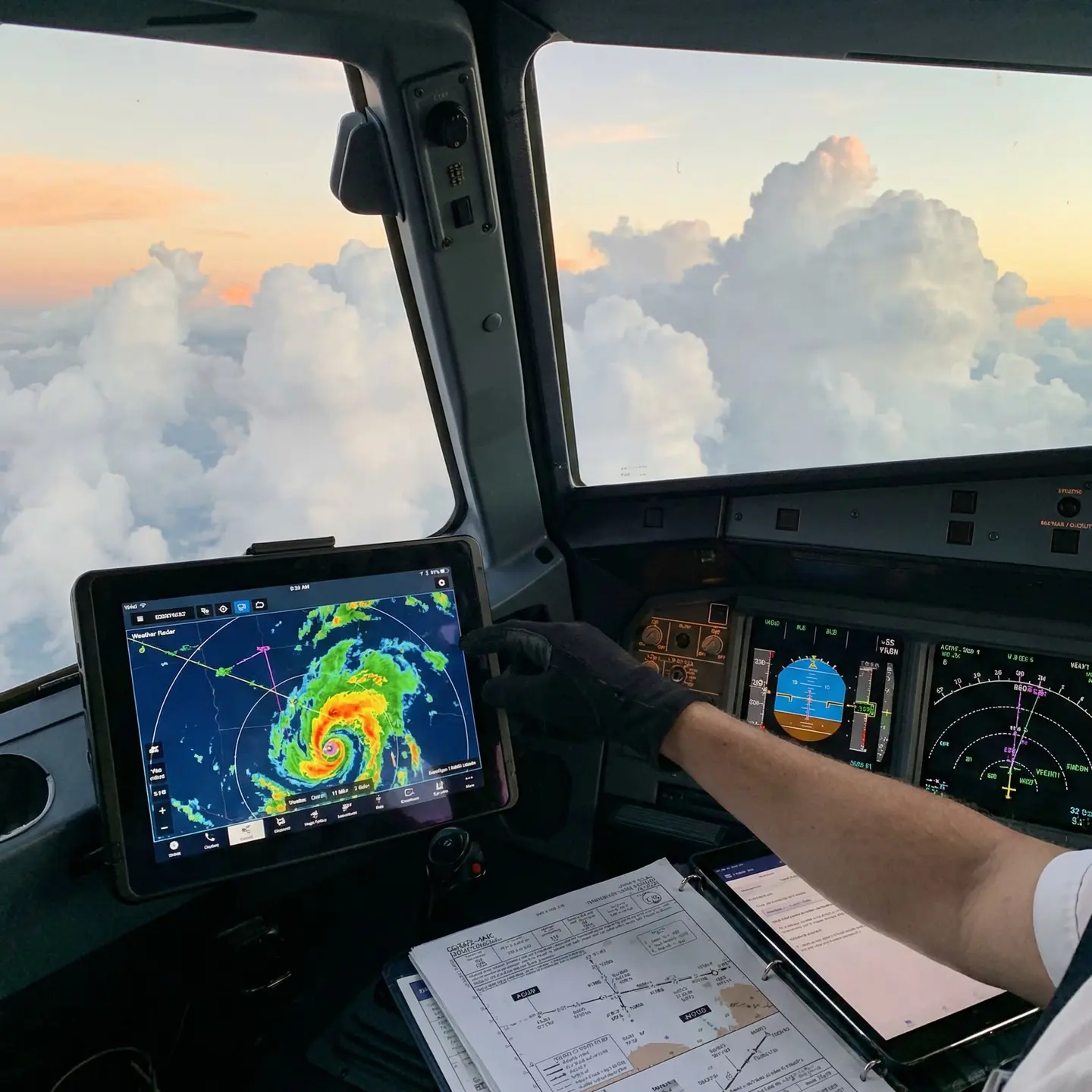
Both PPL and CPL pilots should understand clouds not just by their names, but by the processes that create them. A useful way to organize this knowledge is by the mechanism responsible for their formation:
- Convective clouds (cumulus family): Indicate instability; associated with turbulence, icing in specific temperature ranges, and potential for thunderstorm development
- Stratiform clouds (stratus family): Indicate stability; associated with steady precipitation, restricted visibility, and persistent conditions
- Orographic clouds: Form due to terrain lifting; indicate potential turbulence and icing on the windward side
- Frontal clouds: Form along air mass boundaries; type and sequence indicate frontal position and movement
Precipitation Hazards Beyond “Rain”
Commercial pilots must understand precipitation mechanisms because they determine:
- Freezing rain: Occurs when rain falls through a subfreezing layer near the surface—one of the most dangerous icing conditions because it accumulates rapidly and can affect runway conditions
- Ice pellets (sleet): Indicate a freezing layer aloft; often precede freezing rain as warm fronts approach
- Snow grains vs. snow: Different formation processes with different intensity patterns and visibility impacts
Turbulence Mechanisms
Both PPL and CPL pilots must understand the causes of turbulence, but at the CPL level you’re expected to anticipate where it is likely to occur:
- Convective turbulence: Associated with cumulus development; strongest in and near thunderstorms but present with any significant convective activity
- Mechanical turbulence: Caused by wind flow over terrain or obstacles; predictable based on wind speed and terrain features
- Wind shear turbulence: Occurs at boundaries between air masses moving at different speeds or directions
- Clear air turbulence (CAT): Occurs in cloud-free air, typically near jet streams or strong temperature gradients
Aircraft Icing: Mechanisms, Consequences, and Avoidance
Icing hazards receive enhanced treatment at the CPL level because commercial operations may involve aircraft with different ice protection systems and require decisions about when icing conditions represent no-go situations versus manageable risks.
Formation Mechanisms
Ice accumulates on aircraft when:
- The aircraft surface is at or below 0°C
- Liquid water (usually supercooled droplets) contacts the surface
- Sufficient moisture exists in the atmosphere
The critical temperature range for structural icing is typically 0°C to -20°C, where supercooled water droplets are most common. Below -40°C, most moisture exists as ice crystals that don’t adhere as readily to aircraft surfaces.
Icing Types and Severity
- Rime ice: Forms from small supercooled droplets that freeze instantly on contact; rough, opaque appearance; generally easier to remove
- Clear ice: Forms from larger droplets that flow before freezing; smooth, transparent, dense; more difficult to remove and more disruptive to aerodynamics
- Mixed ice: Combination of both types; common when flying through varied cloud conditions
Transport Canada intensity categories (trace, light, moderate, severe) correlate with accumulation rates and required pilot responses.
Strategic Avoidance Planning
Commercial pilots use forecast products to plan icing avoidance:
- GFA Icing, Turbulence, and Freezing Level charts show forecast icing areas and intensities
- PIREPs provide real-time information about actual conditions
- Temperature and cloud base/top information help identify altitude bands where icing is likely
The operational question isn’t “Will we encounter ice?” but rather “Can we avoid icing altitudes, and if not, can our aircraft handle the forecast conditions with acceptable safety margins?”
Severe Weather Systems: Structure and Commercial Impacts
CPL meteorology requires detailed understanding of weather system structure because commercial pilots must plan around these systems, not simply wait for them to pass.
Frontal Systems and Cross-Section Analysis
Each frontal type produces characteristic weather patterns:
Cold fronts:
- Steep frontal slope creates narrow band of intense weather
- Passage marked by wind shift, temperature drop, pressure rise
- Post-frontal conditions typically good but may include gusty winds
Warm fronts:
- Gentle frontal slope creates broad area of stratiform cloud and precipitation
- Conditions deteriorate gradually as front approaches
- Icing hazards often significant due to extended flight through cloud layers
Occluded fronts:
- Combine characteristics of both warm and cold fronts
- Can produce complex, multi-layered weather requiring careful analysis
TROWALs and Canadian Weather Patterns
A TROWAL (TROugh of Warm Air ALoft) forms when the warm sector of a mature low-pressure system is lifted entirely off the surface during the occlusion process. As the cold front overtakes the warm front, the warm air is forced upward and becomes concentrated in a trough of warm, moist air aloft. TROWALs are often associated with:
- Extensive areas of precipitation
- Multiple cloud layers, which can increase the potential for airframe icing
- Weather that persists longer than a typical frontal passage
Convective Hazards
Thunderstorms and their associated phenomena represent the most significant convective hazards:
- Microbursts: Intense downdrafts producing dangerous wind shear near the surface; can occur with little warning and create impossible performance demands during takeoff or landing
- Gust fronts: Outflow boundaries from thunderstorms that can extend miles from the storm
- Squall lines: Organized lines of thunderstorms that may require significant routing deviations
Comprehensive Weather Products and Decision Making
While private pilots use weather products to make go/no-go decisions, commercial pilots must take this a step further — integrating multiple products and understanding their limitations in order to make more complex operational decisions.
METARs: Advanced Interpretation
Beyond basic decoding, commercial pilots must understand:
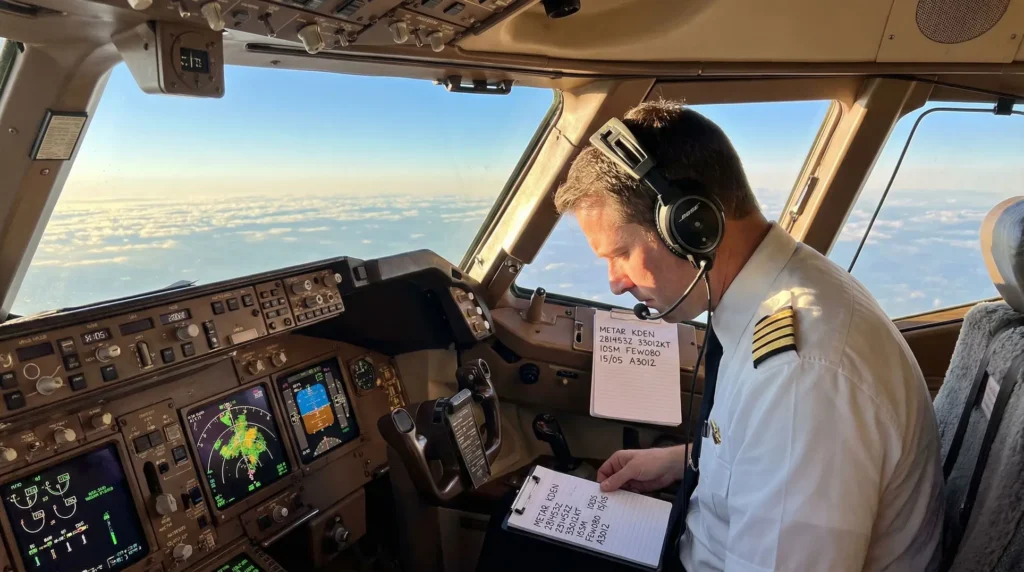
- SPECI reports: Issued when conditions change significantly between routine observations; indicate rapidly evolving weather
- AUTO limitations: Automated stations may not detect all phenomena; exercise increased caution when relying solely on AUTO reports
TAFs: Forecast Application
TAF interpretation at the CPL level focuses on operational application:
- PROB groups: Indicate percentage probability of conditions occurring; 30-40% probability may be acceptable for planning with good alternates but not for marginal situations
- TEMPO groups: Conditions expected for less than half the period; plan fuel and timing to avoid or wait out TEMPO conditions
- BECMG groups: Indicate trend changes; affects whether conditions will improve or deteriorate during your planned arrival window
- FM groups: Indicate a rapid and definite change in conditions at the specified time. Unlike gradual trends, conditions after an FM group replace the previous forecast entirely and persist until the next change group.
Graphic Area Forecasts (GFAs)
The GFA provides the big-picture view, helping connect the conditions reported in individual METARs and TAFs into a broader understanding of the overall weather pattern.
Clouds and Weather:
- Shows forecast cloud layers, precipitation areas, and visibility restrictions
- Allows you to identify areas where conditions may be better or worse than specific aerodrome forecasts suggest
Icing, Turbulence, and Freezing Level:
- Shows forecast icing and turbulence areas with intensities
- Freezing level information helps plan altitudes to avoid or minimize icing exposure
AIRMETs and SIGMETs
These advisory products alert pilots to hazardous conditions:
- AIRMETs: Issued for moderate icing, moderate turbulence, IFR conditions, among other things
- SIGMETs: Issued for severe or extreme conditions including thunderstorms, severe icing, and severe turbulence, among other things
Operationally, SIGMETs typically require routing changes or delays. AIRMETs may be acceptable depending on aircraft capability and pilot experience, but require careful consideration.
Upper-Air Charts
Winds and temperatures aloft charts become essential planning tools at the CPL level:
- Calculate groundspeed and fuel consumption for different cruise altitudes
- Identify altitude bands with favorable or unfavorable winds
- Anticipate temperature-related performance variations
NAV CANADA provides these forecasts through the aviation weather services, and integrating them into flight planning is a core CPL competency.
Pilot Reports (PIREPs)
A PIREP, or Pilot Report, is a report of actual weather conditions observed by a pilot during flight. These reports are typically transmitted to air traffic services or a flight service station, and then distributed to other pilots and meteorological agencies.
PIREP Content and Interpretation
PIREPs report:
- Cloud bases and tops (actual observed versus forecast)
- Turbulence location, intensity, and type
- Icing location, intensity, and type
- Flight visibility and precipitation
Operational Application
Smart PIREP usage includes:
- Timing consideration: Recent PIREPs are more valuable; conditions change, so a PIREP from four hours ago may no longer be relevant
- Location relevance: PIREPs from your planned route are more valuable than distant reports
- Aircraft type awareness: Turbulence reports vary by aircraft size; what a large transport calls “light” may be “moderate” for a smaller aircraft
As a commercial pilot, you should actively solicit PIREPs from ATC or FSS when planning flights into areas with uncertain conditions, and contribute your own reports to help other pilots.
In-Flight Weather Monitoring and Decisions
Meteorology doesn’t end when the flight begins. You must maintain weather awareness throughout the flight and be prepared to modify plans based on updated information.
Information Sources En Route
- ATC/FSS updates: Request weather updates for destination and alternates, especially on longer flights
- Company weather: If operating for an employer, company dispatch may provide updated weather information
- Pilot-to-pilot communication: Other aircraft on frequency may share relevant observations
Decision Points
Commercial pilots establish decision points before departure:
- At what point will you check updated weather?
- What conditions would trigger a diversion to your alternate?
- What conditions would trigger a return to departure point?
Weather-related diversions are not failures—they’re evidence of sound commercial judgment.
Why CPL Meteorology Matters in Exams and Operations
Transport Canada structures the CPL meteorology examination to test operational application, not just knowledge recall. Questions often embed scenarios requiring you to:
- Interpret weather products and determine operational impacts
- Assess whether forecast conditions permit a planned flight
- Identify the most significant hazard in a given weather scenario
- Determine appropriate responses to changing conditions
The fundamental question shifts from PPL’s “What is the weather?” to CPL’s “How does this weather change the plan?” This operational framing appears throughout TP 12881’s meteorology requirements and drives how the examination assesses your competence.
Developing an Operational Meteorology Mindset
The transition from PPL to CPL meteorology represents more than additional content—it requires a fundamental shift in how you think about weather. At the CPL level, weather is not just information to be gathered; it governs whether, how, and with what margin a flight proceeds.
Commercial pilots must:
- Predict: Anticipate how conditions will evolve during the flight
- Plan for uncertainty: Build margins for forecast errors and unexpected changes
- Integrate: Connect weather to fuel planning, route selection, altitude choice, and timing decisions
- Adapt: Modify plans based on updated information rather than pressing on with original intentions
This operational integration distinguishes commercial pilots from recreational pilots and forms a core competency that Transport Canada evaluates throughout the CPL certification process.
If you’re ready to develop these skills systematically, our CPL Ground School covers all meteorology topics required by TP 12881, with clear explanations, practice questions, and the operational context that helps you understand not just what the weather is, but what it means for your flight.
Frequently Asked Questions
How does CPL meteorology differ from PPL, and why does this shift challenge student pilots?
We’ve seen many students struggle with this transition. At PPL, we focus on observing and reacting to current weather via METARs and sky conditions. For CPL, we demand prediction: forecasting evolution, assessing operational impacts on performance, fuel, and routes, and integrating it into every decision. Transport Canada’s TP 12881 tests this operational mindset, not just recognition. Master it early to avoid exam surprises and build the risk-based judgment commercial ops require—it’s the foundation of safe, professional flying.
Why must we analyze lapse rates beyond the standard atmosphere for CPL performance planning?
Non-standard lapse rates trip up many CPL candidates because they directly affect aircraft performance and safety margins. We teach that steeper rates signal unstable air with turbulence and convection risks, while inversions trap fog and limit visibility. Operationally, we calculate density altitude impacts on climb gradients, terrain clearance, and hot/high takeoffs. Without this, altimeter errors over mountains or poor obstacle clearance become real hazards. TP 12881 mandates these applications—practice integrating them with performance charts to confidently plan legal, safe departures.
How do we use adiabatic lapse rates and lifting mechanisms to predict weather hazards in CPL scenarios?
Students often overlook how DALR (3°C/1,000 ft) and SALR (1.5°C/1,000 ft) let us forecast instability. We compare them to environmental rates to predict cloud bases, vertical development, and hazards from frontal, orographic, convective, or convergence lifting. For instance, convective lifting warns of thunderstorms, while subsidence inversions signal persistent low visibility. In CPL exams and ops, this predicts turbulence, icing, and timing—essential for route deviations and no-go calls. We’ll guide you to apply this systematically for proactive planning.
How do we integrate icing forecasts and PIREPs into CPL flight planning to avoid common pitfalls?
Icing often disrupts flight planning because it is treated reactively instead of being anticipated during the planning stage. Commercial pilots must understand the physical mechanisms of icing, particularly the presence of supercooled water droplets where droplets freeze on contact and produce rime or clear ice accretion depending on droplet size and liquid water content. PIREPs provide valuable real-time information on actual icing conditions, including altitude, location, type, and intensity. CPL exams frequently present scenarios requiring candidates to combine forecast products, PIREPs, and aircraft performance considerations to make sound, conservative decisions in icing environments.