Preparing for the Private Pilot Licence written exam in Canada requires more than just studying aviation theory. Understanding how the exam works, what you’re allowed to bring, how it’s scored, and what happens if you don’t pass a section is just as critical as knowing the material itself. We’ve seen students spend months learning meteorology and navigation, only to walk into the exam room uncertain about basic logistics. This guide addresses that gap directly. If you’re training toward your PPL and want to know exactly what Transport Canada expects on exam day, this article is for you. If you’re looking for subject-specific study content, our PPL Ground School covers all the testable material in detail.
Who This Article Is For
This article is designed for student pilots in Canada who are approaching the PPL written exam and want clarity on the process, not the content. If you’re looking for an overview of exam mechanics, scoring requirements, and administrative rules, you’re in the right place.
This article is not a study guide for meteorology, navigation, air law, or general knowledge. We cover those subjects thoroughly in our ground school courses and supporting articles. Here, the focus is strictly on exam format, structure, and logistics—the rulebook side of things.
The PPL Written Exam in Context
The PPL written exam is a mandatory requirement for earning your Private Pilot Licence—Aeroplane in Canada. Transport Canada administers this examination to ensure candidates possess the theoretical knowledge necessary for safe flight operations. The official document defining everything about this exam is TP 12880 – Study and Reference Guide for Written Examinations, Private Pilot Licence—Aeroplane.
The written exam is separate from two earlier milestones in your training:
- PSTAR – The Student Pilot Permit written test, typically completed before solo flight
- ROC-A – The Restricted Operator Certificate (Aeronautical) for radio communications
It is also entirely separate from your flight test, which assesses practical flying skills. You must pass the written exam before Transport Canada will issue your licence, but you do not need to pass it before beginning flight training or even before your flight test—though most students complete it well in advance.
What TP 12880 Is—The Rulebook
TP 12880 is the official Transport Canada publication that defines everything about the PPL written exam. Think of it as the rulebook. It specifies:
- The subjects tested
- The structure and time limits
- Pass requirements and supplementary exam rules
- Prerequisites and allowed materials
Critically, TP 12880 is not a question bank. It does not contain actual exam questions. What it does is define the scope of content that may appear on the exam. If a topic isn’t referenced in TP 12880, it is not guaranteed to be testable.
This is why we always tell students: TP 12880 is the exam rulebook—follow it, and you know what Transport Canada expects.
PPL Written Exam Format (PPAER)
The official designation for the PPL written exam is PPAER—Private Pilot—Aeroplane. Here’s how it’s structured:
- Number of questions: 100 multiple-choice
- Total time: 3 hours
- Overall pass mark: 60%
- Subject area pass mark: 60% in each mandatory subject
This dual requirement is essential to understand. You must achieve 60% overall and 60% in each of four subject areas. A high overall score does not compensate for a low subject score. If you score 70% overall but only 55% in Meteorology, you receive a partial pass—not a full pass.
Mandatory Subject Areas
The PPAER exam tests four mandatory subject areas. Each must be passed independently:
Subject: Air Law – Required Pass: 60%
Subject: Navigation – Required Pass: 60%
Subject: Meteorology – Required Pass: 60%
Subject: Aeronautics—General Knowledge – Required Pass: 60%
Each subject area carries a specific weighting within the 100-question exam. Failing any single subject area—even if your overall score exceeds 60%—results in a partial pass.
Example: Scoring 65% overall with 55% in Meteorology means you must rewrite the Meteorology supplementary exam. You do not need to rewrite the full PPAER.
Supplementary Exams—If Required
If you fail one or more subject areas but pass overall, Transport Canada allows you to write supplementary exams targeting only the failed subjects. These are shorter, focused tests:
Subject: Air Law – Exam Code: PALAW – Questions: 20 – Time: 1 hour – Pass Mark: 60%
Subject: Navigation – Exam Code: PANAV – Questions: 20 – Time: 2 hours – Pass Mark: 60%
Subject: Meteorology – Exam Code: PAMET – Questions: 30 – Time: 1.5 hours – Pass Mark: 60%
Subject: Aeronautics – Exam Code: PAGEN – Questions: 30 – Time: 1.5 hours – Pass Mark: 60%

If you write multiple supplementary exams on the same day, the total combined time is capped at 3 hours. This provision allows candidates to address only their weak areas without repeating the entire exam.
Exam Prerequisites—What You Must Have Before Writing
Before you can write the PPAER, you must meet several prerequisites defined by Transport Canada and TP 12880:
- Valid medical certificate – Category 1, 3, or 4 medical as appropriate
- Acceptable picture identification – Government-issued photo ID
- Letter of Recommendation – Signed by a qualified flight instructor confirming your readiness to write
- Language competency – Ability to read and communicate in English or French
The Letter of Recommendation is non-negotiable. Without it, Transport Canada will not authorize your exam attempt. Your instructor must certify that you have completed adequate ground school training and demonstrated the knowledge necessary to attempt the examination.
This is why completing a structured ground school—like our PPL Ground School—matters. Upon completion, you receive the required documentation to proceed to your written exam.
Materials You Are (and Aren’t) Allowed to Use
Transport Canada specifies exactly what you may and may not bring into the examination room.
Permitted Materials
- Pencil for rough work
- Approved electronic calculator (memory must be cleared)
- Ruler
- Protractor
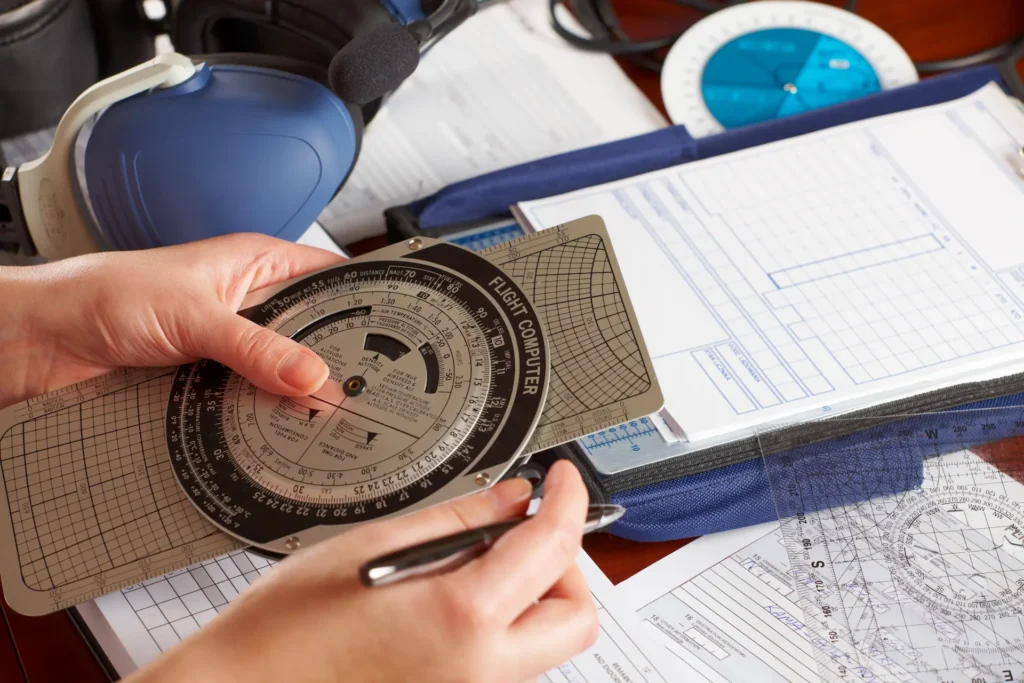
- Flight computer (E6B or approved electronic equivalent)
Not Permitted
- Stored text or notes
- Unauthorized electronic devices
- Assistance from any person
Violations of these rules result in automatic failure and a one-year ban from Transport Canada examinations. This is strictly enforced—do not bring anything into the exam room that could be construed as unauthorized material.
Exam Timing, Validity, and Rewrite Rules
Pass Validity
Your written exam results remain valid for 24 months from the date you pass. If you do not complete your licence issuance within that window, you may be required to rewrite the exam.
Rewrite Waiting Periods
If you fail the exam, Transport Canada imposes mandatory waiting periods before you can attempt it again:
- First failure: 14 days
- Second failure: 30 days
- Third or subsequent failure: 30 days + 30 days per additional failure (up to a maximum of 180 days)
Transport Canada may shorten these waiting periods if the candidate can demonstrate remedial study in the weak knowledge areas identified on the feedback statement. This typically requires instructor endorsement confirming additional training.
What You Receive After the Exam
After completing the PPAER, you receive a feedback statement—not your exam paper, not the correct answers. The feedback statement identifies topic areas where you demonstrated weakness.
For example, instead of telling you which question you answered incorrectly, the statement might indicate:
“Identify the atmospheric conditions favorable for thunderstorm formation.”
This tells you the topic you need to review, not the specific question or answer. The intention is to guide your study without revealing exam content.
Where the Exam Is Written and How to Book
You can write the PPL exam in two primary ways:
- Through an Authorized Examination Invigilator (AEI) – Many flight schools have AEIs on staff who can administer Transport Canada exams on-site
- At a Transport Canada examination centre – Available if AEI access is unavailable in your area
Booking is typically handled through the Transport Canada exam portal or coordinated directly with your flight training unit. Writing locations vary by region across Canada, and most students write at their local flight school if an AEI is available.
Real-World Flight Training Unit Context
To illustrate how this works in practice, consider a typical Canadian flight school pathway. Early in training, students complete the PSTAR (Student Pilot Permit written test) and ROC-A (radio certification). These milestones occur before solo flight privileges.
The PPAER is typically written later in training—often after significant ground school and dual flight instruction. Many flight schools outline clear steps showing when the written exam fits into the overall licence pathway.
Key Takeaways for Students
Before you book your exam, make sure you understand these critical points:
- The exam is not a single score—each subject area must be passed independently
- Knowledge gaps in any subject lead to partial failure—even if your overall score is strong
- Logistics matter—booking, materials, timing, and prerequisites are testable in the sense that failing to meet them prevents you from writing
- Real-world flight school context reduces anxiety—but it does not alter Transport Canada’s exam rules
- Preparation must be balanced—focusing heavily on one subject while neglecting another is a common cause of partial passes
The Bottom Line
TP 12880 is the sole Canadian rulebook for the PPL written exam. Studying exam structure, pass requirements, supplementary rules, and logistics is just as important as studying the content itself. Many students focus exclusively on subject material and arrive at the exam uncertain about basic procedures. That uncertainty creates unnecessary stress.
Know what to expect. Know what you can bring. Know what happens if you fall short in one area. And prepare across all four subjects with equal attention.

For comprehensive coverage of all testable PPL material—Air Law, Navigation, Meteorology, and General Knowledge—our PPL Ground School provides video lessons, practice exams, and a Letter of Recommendation upon completion. For targeted exam practice, our Private Pilot Question Bank includes 15 full-length practice tests mirroring the PPAER format.
The written exam is a defined challenge with clear rules. When you understand both the content and the process, you walk into that exam room with confidence.
Frequently Asked Questions
What is the format of the PPL written exam (PPAER) in Canada?
The PPAER consists of 100 multiple-choice questions over 3 hours. You need 60% overall and 60% in each of four subjects: Air Law, Navigation, Meteorology, and Aeronautics—General Knowledge. Failing one subject, even with a high overall score, means a partial pass and supplementary exams. This dual threshold catches imbalances in prep, so balance your study across all areas to avoid rewrites.
Do I need to pass every subject area separately on the PPL exam?
Yes, you must hit 60% in Air Law, Navigation, Meteorology, and Aeronautics individually, plus 60% overall. A 70% total with 55% in Meteorology? That’s a partial pass—you rewrite just PAMET (30 questions, 1.5 hours). This setup ensures no weak spots in critical knowledge, saving time on targeted supplements instead of the full exam.
What prerequisites do I need before taking the PPAER exam?
You’ll need a valid Category 1, 3, or 4 medical certificate, government-issued photo ID, a Letter of Recommendation confirming readiness, and language proficiency in English or French. No letter? No exam. Ground schools often provide this doc, streamlining your path and easing pre-exam stress.
What materials can I bring to the PPL written exam?
Bring a pencil, cleared-memory calculator, ruler, protractor, and E6B flight computer. Leave notes, phones, or extra devices behind—violations mean automatic failure and a one-year ban. Stick to these basics to focus on your knowledge without risking disqualification on exam day.
What happens if I fail part of the PPL exam or need to rewrite?
Partial passes trigger shorter supplementary exams such as PALAW (20 questions, 1 hour) for failed subjects. Full failures require waiting periods: 14 days for the first attempt, 30 days for the second, and up to 180 days for subsequent attempts. Results are valid for 24 months. Candidates receive a feedback statement highlighting weak topic areas—no answers are shown—to support targeted study and quicker recovery.