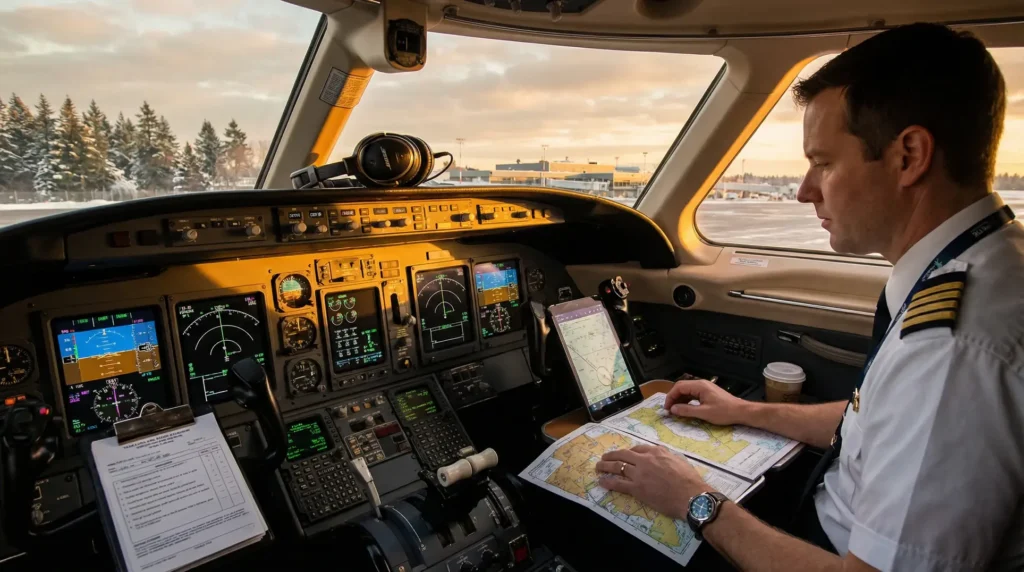
Understanding flight procedures at the IATRA level requires a clear grasp of how the Canadian IFR system functions as an integrated whole, where published procedures, ATC clearances, navigation infrastructure, and pilot responsibilities work together to create safe and orderly operating environment. In this article, we break down the critical flight procedure concepts that IATRA candidates must master, grounded in real-world Canadian IFR operations and the procedural guidance found within Transport Canada publications, the CARs, TC AIM, CAP GEN, and published instrument procedures.
Who This Article Is For

This article is written specifically for Canadian pilots preparing for the IATRA examination who already hold an instrument rating and are working toward type rating eligibility on two-crew aeroplanes. If you are building your foundational IFR knowledge or preparing for the INRAT examination, the procedural concepts discussed here will provide valuable context, though the operational emphasis targets those progressing into high-performance, multi-crew environments.
This article is not intended for pilots seeking instrument flight test preparation, aircraft handling technique guidance, or detailed instrument scan methodology. Our focus remains on procedural understanding, operational logic, and IFR system awareness as it applies to the IATRA examination and real-world airline operations.
How IFR Procedures Are Structured in Canada
Canadian IFR procedures are built around standardized published procedures, ATC clearances, navigation infrastructure, and pilot procedural compliance. This structure exists for essential operational reasons. IFR procedures create predictable aircraft flows while maintaining terrain clearance, traffic separation, and operational efficiency within controlled airspace. When we fly an instrument approach, follow an airway, or execute a holding pattern, we operate within a framework designed to ensure that ATC knows where we are, where we are going, and what altitudes protect us from terrain and traffic conflicts.
The authoritative references governing these procedures include the Canadian Aviation Regulations, TC AIM, CAP GEN, and published instrument procedures including approach plates and enroute charts. These documents do not exist in isolation. They interconnect to form the complete procedural framework that governs every phase of IFR flight in Canada.
Understanding IFR procedures is not simply memorizing procedural steps. Pilots must understand why procedures exist and how they integrate into the larger ATC system. When ATC issues a clearance, that clearance represents one component of a coordinated system designed to maintain separation, sequence traffic, and protect aircraft from terrain. When we fly a published departure procedure, we follow specific tracks and altitudes because those tracks and altitudes have been analyzed for obstacle clearance. Published operational limitations referenced throughout CAP GEN form a major component of procedural IFR knowledge in Canada, and IATRA candidates must demonstrate comprehensive understanding of these concepts.
IFR Flight Phases and Procedural Flow
Every IFR flight follows a structured operational sequence, with specific procedural expectations associated with each phase. From departure through enroute operations, arrival, and approach, pilots must understand what is expected, what protections exist, and what responsibilities remain with the flight crew throughout each segment.
IFR Departure Procedures
The departure phase begins with the IFR clearance, which establishes the initial routing, altitude, and departure instructions. Clearances may specify Standard Instrument Departures, direct routing to a fix, radar vectors, or specific headings to intercept assigned routes. Each clearance type carries different implications for obstacle protection and pilot responsibilities.
An essential clarification that every IATRA candidate must understand involves obstacle clearance during departure. An IFR clearance alone does not automatically guarantee obstacle clearance during all phases of flight unless obstacle protection is provided through published procedures, assigned altitudes, radar vectoring, or other ATC-approved IFR procedures. When we receive a clearance to depart via a Standard Instrument Departure, that SID has been designed with specific obstacle clearance gradients. When we receive radar vectors off a runway without a published departure procedure, ATC assumes responsibility for obstacle clearance through their vector instructions.
Pilot responsibilities during departure include accurate readback of clearances, following all published restrictions on SIDs, and maintaining obstacle awareness throughout the departure phase. These are not passive responsibilities. They require active engagement with the clearance, the published procedure, and the operational environment.
Enroute Procedures
Once established enroute, pilots navigate via airways, RNAV routes, or direct routing as specified in the clearance. The Canadian airway structure utilizes ground based navigation and RNAV routes designated for aircraft meeting specific navigation performance requirements. Regardless of the navigation system employed, pilots must maintain the cleared route and altitude while remaining prepared for ATC amendments, weather deviations, or traffic-related changes.

Position reporting at compulsory reporting points remains required when ATS surveillance is unavailable. Although radar coverage exists throughout most of southern Canada’s high-traffic areas, pilots operating in northern regions or at altitudes below radar coverage must report positions over designated reporting points. These reports provide ATC with the position information necessary to maintain separation in non-radar environments.
Maintaining situational awareness and procedural discipline remains essential even in highly automated aircraft using GPS and flight management systems. Automation reduces workload but does not eliminate the requirement for pilots to understand their position, verify the accuracy of navigation system guidance, and maintain awareness of the procedural requirements associated with their route and altitude. IATRA candidates must recognize that advanced avionics augment pilot decision-making rather than replace it.
Arrival and Terminal Procedures
The transition from enroute to terminal operations involves either published Standard Terminal Arrival Routes or radar vectors provided by approach control. STARs establish predictable arrival flows, altitude restrictions, and speed management requirements that facilitate traffic sequencing into busy terminal environments. When flying a STAR, pilots must comply with all published restrictions unless specifically amended by ATC.
When radar vectors are issued, ATC provides obstacle clearance for those vectors. When pilots are flying published procedures outside of radar vectoring, obstacle clearance relies on adherence to the published procedure and applicable IFR rules. This distinction matters operationally. A pilot receiving vectors to final approach can expect ATC to provide terrain and obstacle separation through those vectors. A pilot cleared for an approach without vectors must ensure compliance with all published altitudes and procedure requirements to maintain obstacle clearance.
Traffic sequencing during arrival often involves speed assignments, vectors for spacing, or holding instructions to manage traffic density. Understanding that these instructions serve flow management purposes helps pilots anticipate operational requirements and maintain appropriate expectations during busy arrival sequences.
Holds, Fixes, and Procedural Positioning Concepts
Holding procedures represent a fundamental IFR skill that extends well beyond the ability to fly a racetrack pattern. Holds serve essential operational functions including traffic sequencing, delay management, traffic spacing, and arrival organization. When traffic volume exceeds airport capacity or when weather, runway closures, or other factors create delays, ATC utilizes holds to absorb that delay safely and systematically.
Holding Entry Methods
Three standard holding entries exist based on the aircraft’s heading when approaching the holding fix.
The direct entry applies when the aircraft approaches the holding fix from a direction that allows direct entry into the holding pattern on the inbound track. The parallel entry applies when the aircraft must first fly a heading parallel to the outbound track before turning back to intercept the inbound course. The teardrop entry involves flying outbound on a track approximately thirty degrees from the outbound course before turning back to intercept the inbound track. Entry determination depends on the relationship between the aircraft’s heading and the holding pattern orientation, and pilots must be able to quickly determine the appropriate entry for any holding clearance.
Holding Clearance Structure
A complete holding clearance contains specific components that pilots must understand and read back accurately.
The holding fix identifies the navaid, intersection, or waypoint around which the hold is established. The radial or track specifies the inbound course to the fix. The direction of turns establishes whether the pattern uses standard right turns or non-standard left turns. Leg timing or distance specifies how far or how long to fly the outbound leg. Altitude restrictions establish the altitude or altitude block within which the hold must be flown. Expect further clearance time provides the time at which pilots should expect an amended clearance.
Standard outbound timing is typically one minute below fourteen thousand feet ASL and one and a half minutes at or above fourteen thousand feet. However, ATC may specify different leg lengths or distances when operational requirements dictate.
Holding procedures require timing accuracy, situational awareness, altitude management, and procedural discipline. Simply maintaining the depicted track is insufficient. Pilots must manage wind correction, monitor timing, maintain altitude precisely, and remain aware of fuel implications when holds extend beyond initial expectations.
Instrument Approach Concepts
Instrument approaches represent the most procedurally complex phase of IFR flight, requiring pilots to transition from enroute or terminal operations to a position from which landing can be accomplished safely. Understanding approach concepts at the IATRA level means grasping the operational logic behind approach design, minima establishment, and procedural requirements rather than simply memorizing technique.
Approach Categories
Instrument approaches fall into three general categories based on the guidance provided during the final approach segment.
Precision approaches, exemplified by the Instrument Landing System, provide both lateral and vertical guidance to the runway threshold. The pilot follows glideslope and localizer indications to a Decision Altitude, at which point the required visual references must be established to continue to landing.
Approach with Vertical Guidance procedures, including LPV approaches utilizing WAAS GPS, provide lateral and vertical guidance but are not technically classified as precision approaches under ICAO definitions. These approaches offer precision-like guidance and typically feature lower minima than traditional non-precision approaches.
Non-precision approaches, including VOR, NDB, LOC, and LNAV procedures, provide lateral guidance only. Pilots descend to a Minimum Descent Altitude and maintain that altitude until either acquiring the required visual references or reaching the missed approach point.
Approach Procedure Segments
Every instrument approach procedure contains defined segments that serve specific operational purposes.
The initial approach segment provides the transition from the enroute or arrival structure to the intermediate segment. Aircraft typically descend during this segment while establishing on the approach course or maneuvering to intercept the final approach course.
The intermediate segment provides a stable platform for aircraft configuration and final approach preparation.
The final approach segment begins at the final approach fix or in the case of a precision approach, where the glide path is intercepted and continues to the runway or missed approach point.
The missed approach segment defines the procedure to be flown when the required visual references are not acquired by the Decision Altitude or missed approach point. This segment includes initial climb instructions, lateral track guidance, and the missed approach holding fix.
Approach Minima
Approach minima represent operational limits established through careful analysis of obstacle clearance, navigation system accuracy, and operational factors. Decision Altitude applies to precision approaches and APV approaches, representing the altitude at which the pilot must have the required visual references to continue the approach or must initiate the missed approach. Minimum Descent Altitude applies to non-precision approaches, representing the lowest altitude to which descent is authorized without the required visual references.
A critical clarification applies here. Approach minima are operational limits, not targets below which a pilot may continue without the required visual reference. Descending below minima without the required visual references violates regulations and creates unacceptable safety risks. The minima exist precisely because obstacle clearance below those altitudes cannot be guaranteed without visual contact with the runway environment.
Missed Approach Procedures
The missed approach must be initiated no later than the DA on a precision approach, the MAP on a non-precision approach, if the required visual references have not been established. This is not discretionary. Pilots must execute the published missed approach procedure unless otherwise instructed by ATC.
An approach clearance authorizes the instrument procedure itself, not a guaranteed landing. Weather conditions may deteriorate, visual references may not be acquired, or other factors may require missed approach execution. Understanding this distinction helps pilots approach every instrument approach with appropriate contingency planning.
For detailed procedural requirements and approach design standards, pilots should reference TC AIM, CAP GEN, and published approach procedures for specific airports. Our IATRA Ground School course provides comprehensive coverage of these concepts with practice questions aligned with the IATRA Study and Reference Guide (TP 13524).
IFR Emergencies and Operational Responsibilities
Abnormal and emergency situations require pilots to apply procedural knowledge while managing increased workload and stress. IATRA candidates must understand both the regulatory requirements and the operational logic behind these procedures.
Lost Communications Procedures
Lost communications procedures, outlined in TC AIM and the CARs, establish predictable actions that allow ATC to anticipate aircraft behavior when two-way radio contact is lost. The general principle requires pilots to continue on their assigned route and altitude, proceeding to a suitable airport for landing while giving consideration to weather conditions and air traffic. Specific altitude and routing rules apply, and pilots must understand these rules thoroughly to respond appropriately when communications failure occurs.
Equipment and Instrument Failures
Equipment failures require immediate assessment of the operational impact, application of appropriate emergency procedures, and notification to ATC as soon as practical. The priority sequence remains constant: aviate, navigate, communicate. First, maintain control of the aircraft. Then, ensure the aircraft is proceeding toward a safe destination. Finally, communicate the situation to ATC and request any necessary assistance.
Unexpected Weather Deterioration
Weather conditions can deteriorate rapidly, requiring pilots to make timely decisions regarding diversions, holding for weather improvement, or requesting alternative routing. When weather at the destination deteriorates, pilots must have alternate planning in place and be prepared to execute that alternate plan without hesitation. IATRA candidates must understand that weather assessment and contingency planning represent ongoing responsibilities throughout every IFR flight, not merely preflight planning tasks.
Diversions and Missed Approaches
Diversion decisions require assessment of fuel state, weather at alternate airports, aircraft status, and operational considerations. When a missed approach becomes necessary, pilots must fly the published missed approach procedure while coordinating with ATC for subsequent intentions. Repeated approaches, holds for weather improvement, or diversion to an alternate all represent valid options depending on circumstances.
When abnormal situations occur, pilots are expected to prioritize aircraft control, comply with applicable procedures, notify ATC as soon as practical, and apply the appropriate lost communication or emergency procedures outlined in the CARs and TC AIM. These procedures exist precisely because abnormal situations occur, and having well-defined responses allows both pilots and controllers to manage these situations safely.
Procedural Knowledge: Where INRAT and IATRA Focus
Both the INRAT and IATRA examinations assess procedural IFR knowledge, but with different operational emphases reflecting the different pilot qualifications these examinations support.
INRAT Examination Focus
The INRAT examination focuses heavily on IFR regulations, navigation systems, flight planning, instrument approach procedures, weather interpretation, and IFR operational rules. This examination establishes that pilots possess the foundational IFR knowledge necessary for single-pilot instrument operations. Questions emphasize regulatory compliance, navigation system operation, weather assessment, and approach procedure requirements.
IATRA Examination Focus
The IATRA examination places greater emphasis on operational decision-making, procedural integration, ATC interaction, high-performance operational environments, and multi-crew operational awareness. The fifty multiple-choice questions assess knowledge appropriate to two-crew aeroplanes, including weight and balance calculations, human factors considerations, and advanced aeronautical knowledge. IATRA candidates must demonstrate understanding of how procedures integrate within complex operational environments where crew coordination, time pressure, and system complexity add dimensions not present in single-pilot operations.
Both INRAT and IATRA require pilots to understand how published IFR procedures integrate with the Canadian ATC system rather than simply memorizing isolated facts or terminology. The procedural emphasis throughout these examinations reflects Transport Canada’s recognition that safe IFR operations depend on comprehensive understanding of procedural logic, not merely rote memorization of rules.
Putting It All Together
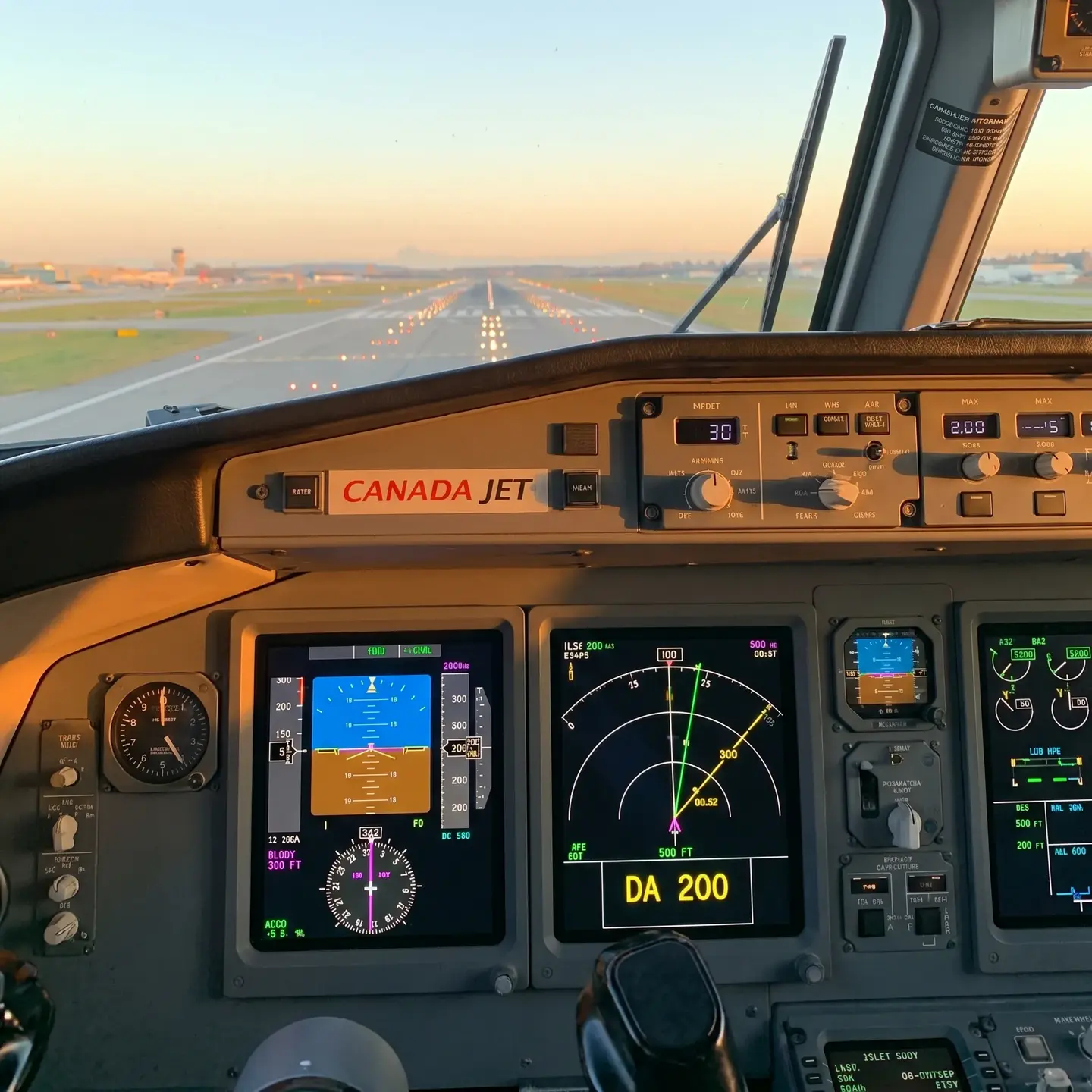
Canadian IFR procedures are built around structured, predictable, ATC-integrated operations that rely on accurate navigation, procedural compliance, disciplined communication, and sound operational decision-making. Both INRAT and IATRA candidates must understand how departures, holds, arrivals, approaches, and ATC clearances function together within the Canadian IFR system. This understanding cannot be developed through memorization alone. It requires studying the procedures, understanding their purpose, and recognizing how each component contributes to the integrated system that keeps IFR operations safe and efficient.
For pilots preparing for the IATRA examination, we encourage comprehensive review of the Transport Canada Study and Reference Guide, TC AIM, and CAP GEN alongside structured ground school preparation. The concepts covered in this article form the procedural foundation upon which more advanced operational knowledge builds.
Flight procedures are not just sequences of actions. They are structured, ATC-integrated processes that demand precise understanding of clearances, procedures, and operational system logic.
FAQ: Mastering Canadian IFR Procedures for IATRA Success
How do we determine the correct holding entry?
In operational reality, misjudging holds disrupts sequencing and fuel planning, a common IATRA pain point. We assess our heading relative to the holding fix: direct entry aligns inbound; parallel requires a 180° turn after parallel outbound; teardrop offsets 30° outbound.
What protections apply when ATC issues radar vectors during terminal arrivals?
We fly vectors precisely as ATC assumes full obstacle and terrain separation responsibility. Outside vectors, we adhere to STAR altitudes and speeds for self-protected flows. This distinction, rooted in TC AIM and CARs, enables efficient sequencing into saturated airports, demanding we anticipate speed assignments and holds while briefing contingencies for two-crew ops.