Understanding air law is not about memorizing legal jargon—it is about knowing what we are legally allowed to do as pilots, where we may fly, and under what conditions we may operate within Canadian airspace. For student pilots preparing for the Transport Canada Private Pilot Licence written examination, air law forms one of the most critical knowledge areas because it establishes the legal foundation upon which every flight operation is built. Without a solid grasp of these rules, we cannot safely or legally exercise the privileges our licence will grant us.
In this guide, we will walk through the foundational air law principles that every PPL candidate must understand. We will cover the legal authority of the private pilot licence, the structure of Canadian airspace, visual flight rules and weather minima, aerodrome operations, and the regulatory framework that governs how we conduct ourselves as pilots-in-command. This material aligns directly with TP 12880, Transport Canada’s official study and reference guide for the PPL written examination, and draws from the Canadian Aviation Regulations and the Transport Canada Aeronautical Information Manual. For comprehensive PPL exam preparation that covers all required subjects, our PPL Ground School provides structured video lessons and practice materials aligned with Transport Canada standards.
Table of Contents

What “Air Law” Means for the Canadian PPL Examination
Before we dive into specific regulations, we need to understand exactly what Transport Canada means by “Air Law” for PPL purposes. This is not abstract legal theory or international aviation law—it is practical, exam-relevant knowledge drawn from specific Canadian sources.
Transport Canada defines Air Law for the PPL examination as knowledge derived from:
- The Canadian Aviation Regulations (CARs)
- The Transport Canada Aeronautical Information Manual (TC AIM)
- The Designated Airspace Handbook (by reference)
The examination standards require a minimum score of 60 percent in the Air Law subject area and a minimum overall score of 60 percent to pass the written examination. If a candidate fails the Air Law section specifically while achieving an overall passing grade, they must write a supplementary Air Law examination (PALAW) before proceeding. This underscores how seriously Transport Canada treats this knowledge area.
Who This Article Is For
This article is designed for student pilots actively preparing for the Transport Canada PPL written examination who need to understand the legal framework governing private pilot operations. It is also valuable for flight instructors seeking a structured reference for teaching air law concepts.
This article is not intended for pilots seeking advanced IFR procedures, commercial operating regulations, or international aviation law comparisons. We focus exclusively on what PPL candidates need to know for Canadian operations under visual flight rules.
Legal Authority to Fly: Licence Privileges and Limitations
The Canadian Aviation Regulations Part IV establishes who may fly, what they may do, and under what circumstances. As private pilot licence holders, our privileges are clearly defined—and so are our limitations.
PPL Privileges Under CAR 401.26
A holder of a private pilot licence—aeroplane may:
- Act as pilot-in-command or co-pilot of an aeroplane for which they are endorsed
- Act as pilot-in-command of an ultra-light aeroplane
These privileges define what we are legally permitted to do. However, they do not override airspace restrictions, weather limitations, or aircraft requirements. A valid PPL does not grant automatic access to all Canadian airspace—it grants the privilege to operate within airspace where our licence, aircraft, and conditions permit.
The Hire or Reward Restriction Under CAR 401.28
Private pilots may not fly for hire or reward. This is a fundamental limitation that distinguishes private from commercial operations. However, the regulations permit specific exceptions:
- Cost-sharing: We may share the direct operating costs (fuel, oil, airport fees) with passengers, provided we pay our proportionate share
- Incidental passengers: Passengers may be carried when their transport is incidental to the purpose of the flight
- Employer reimbursement: We may be reimbursed by an employer when flying is incidental to our employment duties
- Charitable and public security flights: Certain non-profit operations are permitted
- Limited agricultural operations: Specific agricultural work may be conducted under defined conditions
Understanding these limitations matters for airspace compliance because commercial operations require different licences, aircraft certification, and operational authority. Operating commercially without proper authorization violates both licensing and operating regulations.
Aircraft Registration and Legal Dispatch
Before any aircraft may be legally flown in Canada, it must be properly registered with Transport Canada. The Certificate of Registration establishes legal custody and control of the aircraft and must be carried on board during all flights.
Registration becomes invalidated when:
- The registered owner transfers legal custody
- The aircraft is destroyed or permanently withdrawn from use
- The aircraft becomes registered in another country
- Thirty days have elapsed since a change of legal custody without notification to Transport Canada
As pilots, we must verify that the aircraft we intend to fly holds a valid Certificate of Registration before departure. Legal airworthiness is not optional—an aircraft must be legally registered before it may be legally flown.
Canadian Airspace Structure: Where We May Legally Fly
Canadian airspace is organized into seven distinct classifications, each with specific requirements for entry, communication, and equipment. Understanding this structure is essential because it determines where we may operate under visual flight rules and what procedures we must follow.
Class A Airspace
Class A airspace extends from Flight Level 180 to Flight Level 600. This airspace is exclusively reserved for instrument flight rules operations. VFR flight is prohibited in Class A airspace without exception. Private pilots operating VFR will never legally enter Class A airspace.
Class B Airspace
Class B airspace generally exists between 12,500 feet ASL and 17,999 feet ASL, though specific boundaries vary. Both IFR and VFR flights require ATC clearance to enter Class B airspace. VFR operations in Class B are conducted under Controlled VFR (CVFR) procedures, requiring a clearance and continuous transponder operation with Mode C altitude reporting. Class B is transponder airspace—aircraft must be equipped with functioning Mode C transponders to operate within it.
Class C Airspace
Class C airspace surrounds busy airports with moderate to high traffic volumes. Both IFR and VFR flights require ATC clearance before entry. VFR pilots receive traffic information from ATC but remain responsible for maintaining their own separation from other aircraft. Two-way radio communication and Mode C transponder equipment are required.
Class D Airspace
Class D airspace typically surrounds airports with control towers and moderate traffic levels. IFR flights require clearance, while VFR flights must establish two-way radio communication with the appropriate ATC unit before entry. Note the distinction: VFR pilots do not require a clearance for Class D—only two-way communication. ATC provides traffic information, but VFR pilots retain separation responsibility.
Class E Airspace
Class E is controlled airspace that permits VFR flight without requiring ATC clearance or prior communication. This includes low-level airways and control extensions around some airports. While ATC may provide flight information services, pilots are responsible for maintaining separation from all other aircraft. Class E represents a transition between fully controlled and uncontrolled airspace environments.
Class F Airspace
Class F encompasses special-use airspace and comes in one of several forms:
- CYR (Restricted): Authorization is required before entry. Operations may be prohibited or restricted due to military activity, aerial demonstrations, or other hazards
- CYA (Advisory): Entry is permitted, but pilots should be aware of activities that may create hazards. Caution is advised when transiting advisory areas
- Military operations area (MOA): An airspace of defined dimensions established to segregate certain military activities from IFR traffic and to identify, for VFR traffic, where these activities are conducted.
- Danger Area (International Waters): A danger area is Class F airspace that may be established over international waters but within Canada’s area of responsibility for providing ATS, as agreed to with ICAO. This is an airspace of defined dimensions within which activities dangerous to the flight of aircraft may exist at specified times. ATC clearances will not be issued for non-participating flights to enter a danger area. Aircraft should avoid flight in danger areas unless participating in the activity taking place therein
Before flight, pilots must check NOTAMs to determine whether restricted areas are active and whether advisory areas contain activities that may affect their planned route.
Class G Airspace
Class G is uncontrolled airspace where no ATC services are provided, though pilots may request flight information and alerting services from flight service stations. Both IFR and VFR flights are permitted, with pilots bearing full responsibility for maintaining separation from all traffic. Class G extends from the surface to the base of overlying controlled airspace.
Rules of the Air: Collision Avoidance and Minimum Altitudes
The Canadian Aviation Regulations Part 602 establishes the rules of the air that govern how we conduct flight operations. These rules apply regardless of airspace classification.
Right-of-Way and Collision Avoidance
The fundamental principle underlying all right-of-way rules is that every pilot must take whatever action is necessary to avoid a collision, regardless of who has the right-of-way. When two aircraft are converging at approximately the same altitude, the aircraft with the other on its right must give way.
The general right-of-way hierarchy requires that:
- Power-driven heavier-than-air aircraft give way to airships, gliders, and balloons
- Airships give way to gliders and balloons
- Gliders give way to balloons
- Power-driven aircraft give way to aircraft towing or carrying slung loads
Aircraft that are landing or on final approach have the right-of-way over aircraft in flight or maneuvering on the ground. When two aircraft are approaching to land, the aircraft at the lower altitude has the right-of-way, but the lower aircraft may not cut in front of or overtake the higher aircraft on final approach.
Minimum Altitude Requirements Under CAR 602.14
Minimum altitude requirements ensure that aircraft can reach a safe landing area in the event of an emergency and prevent disturbance to persons and property on the ground.
Over built-up areas: Aircraft must maintain an altitude of at least 1,000 feet above the highest obstacle within a horizontal radius of 2,000 feet from the aircraft. Additionally, the aircraft must be at an altitude that would permit safe landing in the event of engine failure.
Over other areas: Aircraft must not operate closer than 500 feet to any person, vessel, vehicle, or structure.
Over national parks and wildlife areas: A minimum altitude of 2,000 feet AGL applies over designated national parks, provincial parks, and wildlife areas to minimize disturbance to wildlife and park visitors.
Aerobatic Flight Restrictions
Aerobatic flight is prohibited (exceptions apply):
- Over a built-up area
- Over an open-air assembly of persons
- In controlled airspace without ATC authorization
- Below minimum altitudes that would permit recovery from unusual attitudes
- When flight visibility is less than three miles
VFR Weather Minima: When We May Legally Fly
Visual flight rules require specific minimum visibility and cloud clearance conditions that vary by airspace classification and altitude. These are not guidelines—they are legal minimums that determine whether VFR flight is permitted.
VFR Weather Minima in Controlled Airspace
In controlled airspace (Classes B through E) and within control zones, the following minima apply:
- Flight visibility: Not less than 3 miles (ground visibility when reported)
- Distance from cloud: 500 feet vertically, 1 mile horizontally
VFR Weather Minima in Uncontrolled Airspace
At or above 1,000 feet AGL:
- Day: 1 mile flight visibility, 500 feet below cloud, 2,000 feet horizontally from cloud
- Night: 3 miles flight visibility, 500 feet below cloud, 2,000 feet horizontally from cloud
Below 1,000 feet AGL (day only for fixed-wing aircraft):
- Day: 2 miles flight visibility, clear of cloud (fixed-wing)
- Day: 1 mile flight visibility, clear of cloud (helicopters)
- Night: 3 miles flight visibility, clear of cloud
Special VFR Operations
When weather conditions within a control zone are below standard VFR minima, pilots may request Special VFR authorization from ATC. SVFR requires:
- Flight visibility of at least 1 mile for fixed-wing aircraft (½ mile for helicopters)
- Remaining clear of cloud at all times
- Maintaining visual reference to the surface
- ATC authorization before conducting the flight
SVFR is a tool for operating in marginal conditions—not a method for conducting flight in instrument meteorological conditions. Pilots must be certain that conditions are sufficient for safe visual flight before requesting SVFR.
VFR Over-the-Top Operations
VFR Over-the-Top (OTT) permits flight above a cloud layer during cruise while maintaining VFR status. This operation requires specific conditions:
- At least 1,000 feet vertical distance from cloud
- If between two layers, at least 5,000 feet vertical separation between layers
- Flight visibility at cruise altitude of at least 5 miles
- Destination weather forecast showing no broken, overcast, or obscured layer below 3,000 feet above planned arrival altitude, with visibility of 5 miles or greater
VFR Cruising Altitudes Under CAR 602.34
When operating more than 3,000 feet AGL, VFR aircraft must maintain specific cruising altitudes based on magnetic track (in the Southern Domestic Airspace) or true track (in the Northern Domestic Airspace):
- Eastbound (000° to 179°): Odd thousands plus 500 feet (3,500, 5,500, 7,500, etc.)
- Westbound (180° to 359°): Even thousands plus 500 feet (4,500, 6,500, 8,500, etc.)
These altitude assignments provide vertical separation between aircraft flying in opposite directions.
Altimeter Setting Procedures
Canada is divided into two altimeter regions that determine how pilots set their altimeters:
Altimeter Setting Region: Pilots set the current altimeter setting from a local reporting station. This provides indicated altitude above mean sea level.
Standard Pressure Region: Pilots set 29.92 inches of mercury (1013.2 hectopascals). This provides pressure altitude, not true altitude above sea level.
When transitioning between regions, pilots must adjust altimeter settings accordingly. In the Standard Pressure Region, vertical separation between aircraft is maintained by pressure altitude, so all aircraft use the same reference regardless of local pressure variations.
Aerodrome Operations as Air Law
Aerodrome operations are governed by air law principles that establish communication requirements, circuit procedures, and operational standards.
Controlled Versus Uncontrolled Aerodromes
At controlled aerodromes (with operating control towers), pilots must obtain clearance before taxiing, taking off, or landing. All instructions from ATC are mandatory unless compliance would create an unsafe situation.
At uncontrolled aerodromes, pilots are responsible for self-announcing positions and intentions on the appropriate frequency.
Mandatory Frequency and Aerodrome Traffic Frequency Areas
Mandatory Frequency (MF) areas require all aircraft to monitor and communicate on the designated frequency. Specific position reports are required:
- Before entering the MF area
- When joining the circuit
- When on downwind, base, and final legs
- When clear of the runway after landing
Aerodrome Traffic Frequency (ATF) areas recommend communication but do not mandate it. However, prudent pilots will broadcast their positions regardless of whether the area is MF or ATF.
Circuit Procedures
Standard circuit procedures require left-hand circuits unless otherwise published. Circuit altitude is typically 1,000 feet above aerodrome elevation unless specified differently in the Canada Flight Supplement. Pilots conducting continuous circuits must announce their intentions on each circuit.
Emergencies, Wildlife, and Authority
The regulations establish specific requirements for emergency situations and wildlife hazards that pilots must understand.
Emergency Authority and Compliance
During emergencies, the pilot-in-command has the authority to deviate from any regulation to the extent required to meet the emergency. However, pilots must report any deviation to Transport Canada if requested.
At aerodromes, emergency response authorities may direct aircraft operations during emergency situations. Pilots are obligated to comply with instructions from on-scene coordinators when airport emergencies are declared.
Wildlife Strike Reporting
Pilots must report wildlife strikes to Transport Canada. This reporting supports wildlife hazard management programs at Canadian airports. Additionally, pilots should report wildlife activity that may create hazards for other aircraft, particularly concentrations of birds near airports or along approach and departure paths.
Radio Communication, Interception, and Security
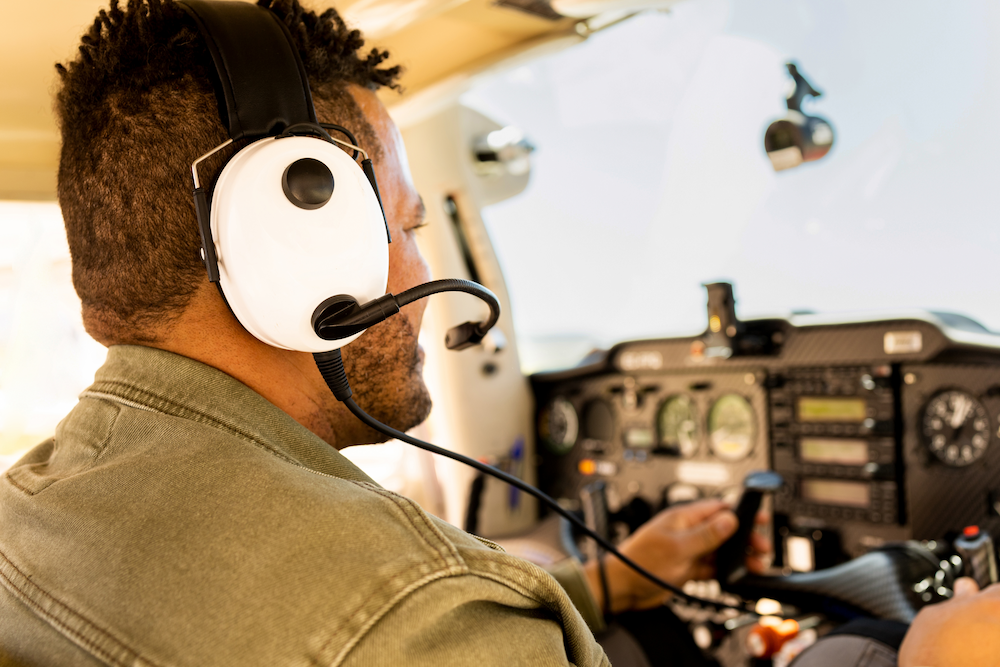
Communication Requirements
Pilots operating in controlled airspace must maintain continuous listening watch on the appropriate frequency. Radio communications must be conducted in English or French, depending on the facility being contacted.
Interception Signals
All pilots must be familiar with interception signals and procedures. If intercepted by military aircraft:
- Follow the intercepting aircraft’s instructions
- Attempt communication on 121.5 MHz (international emergency frequency)
- Squawk 7700 if unable to establish communication
ADIZ Requirements
The Canadian Air Defence Identification Zone (ADIZ) requires specific flight plan and position reporting procedures for aircraft entering or operating within ADIZ boundaries. VFR flights entering the ADIZ must file a flight plan and report their position when entering the zone.
How Transport Canada Tests Air Law
Transport Canada examination questions frequently present scenario-based situations that require candidates to apply multiple regulatory concepts simultaneously. Questions often blend airspace classification with weather minima, altimetry procedures, and licence privileges.
The Foundation for Safe Operations
Air law provides the legal framework within which we operate as pilots. A pilot’s licence defines what we may do; airspace rules define where we may do it—and neither overrides the other. Understanding this relationship is essential for safe, legal flight operations.
The regulations we have covered establish the boundaries of private pilot operations in Canada. Within these boundaries, we have significant freedom to conduct flights for personal purposes, build experience, and develop our skills. Outside these boundaries, we expose ourselves to enforcement action and, more importantly, to safety risks that the regulations are designed to prevent.
For structured preparation that covers all PPL ground school subjects including air law, navigation, meteorology, and flight operations, our PPL Ground School provides comprehensive video lessons, practice examinations, and study materials aligned with Transport Canada’s TP 12880 standards. Thorough preparation in air law not only supports examination success—it builds the foundation for safe decision-making throughout your flying career.
Frequently Asked Questions
What are the key privileges and limitations of a Canadian Private Pilot Licence (PPL) under CAR 401.26 and 401.28?
Hey there, student pilot—feeling overwhelmed by all those regs? A PPL lets you act as pilot-in-command or co-pilot on endorsed aeroplanes, fly ultra-lights, and do non-commercial training under supervision (no passengers). But no flying for hire or reward, except cost-sharing fuel/oil (you pay your share), incidental passengers, employer reimbursements, charity flights, or limited ag work. This keeps you legal and safe—ignore it, and you’re risking your licence and safety on every trip.
What are the VFR weather minima I need to know for different airspaces and altitudes?
Tired of second-guessing if it’s flyable? In controlled airspace (B-E), it’s 3 SM visibility, 500 ft below/1 SM from clouds. Uncontrolled above 1,000 ft AGL: 1 SM day/3 SM night, clear by 500 ft/2 SM. Below 1,000 ft: 2 SM day fixed-wing, clear of clouds. Special VFR in control zones needs 1 SM and ATC okay. Nail these to fly confidently without busting mins and stressing over weather traps.
Can I share costs with passengers on my private flights, and what counts as ‘hire or reward’?
Worried about splitting gas with buddies? Yes, share direct costs like fuel, oil, and fees if you pay your share—no profit allowed. Exceptions include incidental passengers or employer reimbursements, but never fly for pay. This common pain point trips up new pilots—stick to it, and you’ll enjoy fun flights without enforcement headaches or licence drama.