The Canadian Airline Transport Pilot Licence – Aeroplane represents the highest level of pilot certification issued by Transport Canada, and the written examination requirement forms a critical part of that qualification. Before we can hold an ATPL-A, we must have a thorough understanding of the knowledge areas outlined in Transport Canada’s official Study and Reference Guide, TP 690E, by passing two separate written examinations: the SARON and SAMRA. This article is not a subject-by-subject study guide. We are not here to teach Air Law, Meteorology, or Flight Planning in depth. Instead, our purpose is to explain exactly how the ATPL written exams are structured, what subject areas they cover according to TP 690E, and how we should approach multiple-choice exam writing with disciplined strategy. Understanding the blueprint is the first step toward building an effective study plan.
Who This Article Is For
This article is written for Canadian pilots who are preparing to write the ATPL-A written examinations and want to understand the exam structure before diving into content review. If we already hold a Commercial Pilot Licence and an Instrument Rating, and we are building toward the ATPL, this breakdown will help us see the scope of what lies ahead.

This article is not for pilots looking for a detailed explanation of meteorology charts, navigation formulas, or aircraft systems theory. Those topics require dedicated study through proper ground school resources. Here, we focus on the examination framework itself.
What the ATPL Written Exams Are
Transport Canada publishes TP 690E, the Study and Reference Guide for the Written Examinations for the Airline Transport Pilot Licence – Aeroplane. This document is the authoritative source that defines what candidates are expected to know and how the examinations are organized.
According to TP 690E, Transport Canada expects applicants to have mastered the various subjects included in the guide and to demonstrate that by passing the two written examinations. There is no mandatory ground school for the ATPL-A written examinations. However, the breadth of material covered means that structured preparation through a comprehensive ATPL ground school is highly advisable.
It is also important to note that an ATPL-A applicant requires a Group 1 instrument rating.
Overall Exam Structure
The ATPL-A written examination requirement consists of two separate multiple-choice examinations:
- SARON – Aviation Regulations and Air Traffic Procedures, Aeroplane Operations and General Navigation
- SAMRA – Meteorology, Radio Aids to Navigation and Flight Planning
Both examinations share the same format parameters:
SARON
- 80 questions
- 3.5 hours (3 hours 30 minutes)
- 70% pass mark
SAMRA
- 80 questions
- 3.5 hours (3 hours 30 minutes)
- 70% pass mark
SARON covers Sections 1 through 7 of TP 690E. SAMRA covers Sections 8 through 10 of TP 690E. Both examinations must be passed as part of the ATPL-A knowledge requirement. Neither exam can be bypassed or substituted.
SARON — What It Covers
SARON draws its questions from Sections 1 through 7 of TP 690E. This examination tests our knowledge across the following subject areas:
TP 690E SARON Sections
- Section 1: Air Law and Procedures
- Section 2: Airframes, Power Plants, Propellers and Aircraft Systems
- Section 3: Instruments
- Section 4: Navigation – General
- Section 5: Flight Operations
- Section 6: Theory of Flight
- Section 7: Human Factors
SARON therefore draws from regulatory knowledge, aircraft systems, flight instruments, general navigation principles, flight operations procedures, aerodynamic theory, and human factors considerations. The scope is broad, and the questions may reference Canadian Aviation Regulations, associated standards, and operational procedures relevant to airline transport operations.
We are not explaining the content of those subjects here. Our focus is on understanding that SARON covers these seven sections, and our study plan must address all of them.
SAMRA — What It Covers
SAMRA draws its questions from Sections 8 through 10 of TP 690E. This examination tests our knowledge across the following subject areas:
TP 690E SAMRA Sections
- Section 8: Meteorology
- Section 9: Flight Planning
- Section 10: Radio Communications and Aids to Navigation – Basic Principles and Use
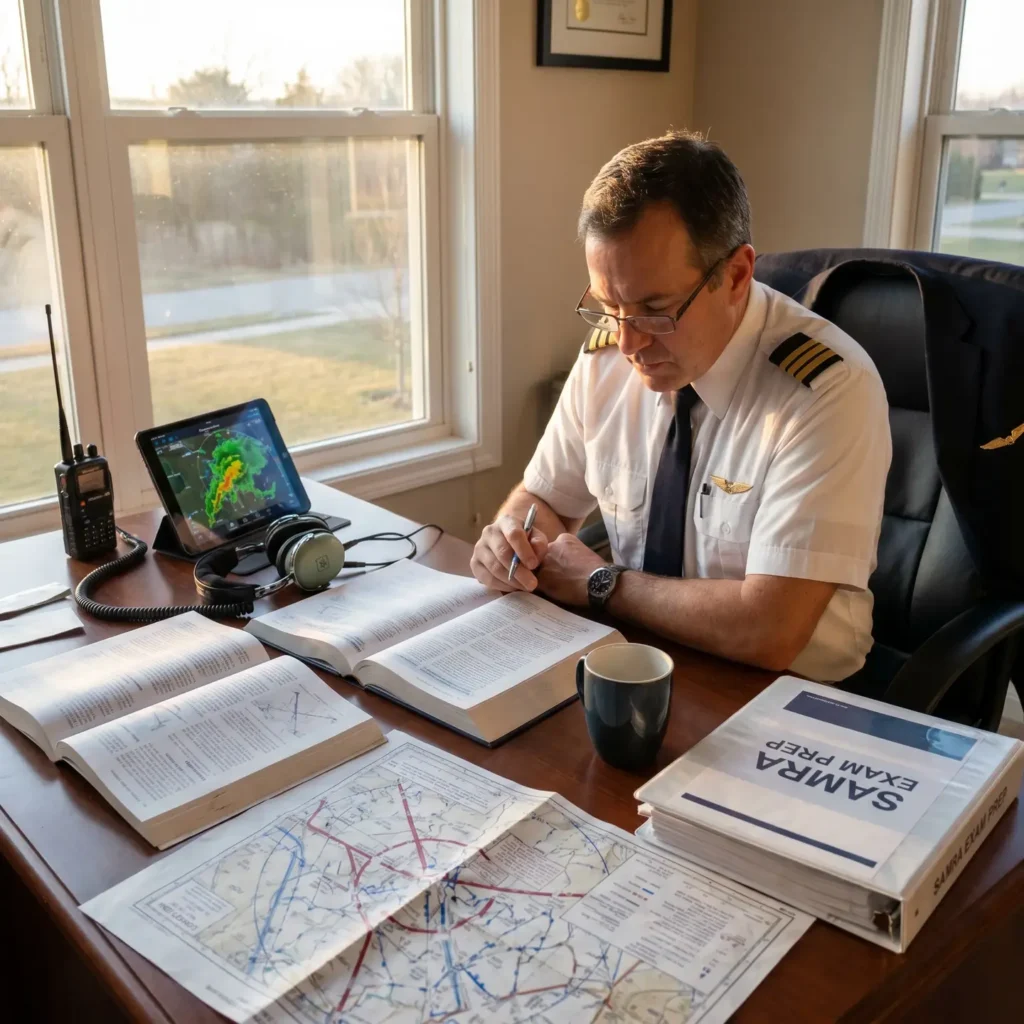
SAMRA therefore draws from meteorological theory and interpretation, flight planning calculations and procedures, radio communications, and navigation aids. These subjects require us to understand weather phenomena, plan flights using appropriate fuel calculations and performance data, and apply radio navigation systems correctly.
Again, we are not teaching those subjects here. We are mapping what SAMRA covers so that our preparation targets the correct material.
Permitted Materials During the Examination
TP 690E specifies what materials we are permitted to use during the SARON and SAMRA examinations:
- Pencil for rough work
- Electronic calculator – permitted only if the memory is cleared before and after the examination
- Navigation ruler or scale
- Manual flight computer (E6B or equivalent)
Computers or devices capable of storing text are not approved. We cannot bring tablets, smartphones, or programmable calculators that retain data. The calculator memory must be verifiably cleared, and examination invigilators may check this.
Knowing what tools we can use allows us to practice with the same equipment we will have on exam day. There should be no surprises when we sit down to write.
Validity, Rewrites, and Feedback
Transport Canada has specific rules governing examination validity and rewrite waiting periods.
Examination Validity
Examinations required for the issuance of a licence or rating must be completed within the 24-month period immediately before the date of application. This means that if we pass SARON but wait more than 24 months before applying for the ATPL-A, the result may no longer be valid. We must plan our examination timing carefully.
Rewrite Waiting Periods
According to CAR 400.04, if we do not pass an examination, the following waiting periods apply before we can attempt a rewrite:
- First failure: 14 days
- Second failure: 30 days
- Third or subsequent failure: 30 days plus an additional 30 days for each failure beyond two, up to a maximum of 180 days
These waiting periods are mandatory. We cannot shorten them by any means, so it is far better to prepare thoroughly and pass on the first attempt.
Feedback Statements
Transport Canada provides feedback statements in the results letter to show where questions were answered incorrectly. This feedback indicates the subject areas where we were weak, not the specific questions or correct answers. If we need to rewrite, we should use this feedback to focus our study on the areas that need improvement.
Strategy for Writing the SARON and SAMRA
Knowing the subject areas is essential, but knowing how to write a multiple-choice examination effectively is equally important. The following strategies are practical approaches to Transport Canada written exams.
RTFQ² — Read the Full Question Twice
Many examination mistakes happen because we answer the question we expected, not the question that was actually asked. Before looking at the answer options, we must read the full question carefully. Then we read it again.
Identify Key Words
Transport Canada questions often hinge on specific words that change the meaning entirely. Watch for:
- not, except
- most correct, best
- required, prohibited
- minimum, maximum
- before, after
- day, night
- IFR, VFR
- commercial, private
- PIC, co-pilot, operator
A question asking what is not required is the opposite of a question asking what is required. Missing that one word can cost us the mark.
Eliminate Wrong Answers First
When we are unsure of the correct answer, we start by eliminating options that are clearly wrong. If we can remove two obviously incorrect choices, we have a 50% chance even if we must guess between the remaining two. This systematic approach improves our odds significantly.
Do Not Second-Guess Without a Reason
Our first instinct is often correct, especially after thorough study. If we change an answer, we should have a clear reason for doing so. Changing answers based on vague doubt usually results in changing correct answers to incorrect ones.
Mark, Move, and Return
If a question is taking too long and we are stuck, we mark it, move on, and return later. There are 80 questions in 3.5 hours, which gives us approximately 2.5 minutes per question on average. Burning 10 minutes on a single difficult question is poor time management. Sometimes, later questions will jog our memory or provide context that helps us answer earlier ones.
Watch Units and Details
Pay attention to:
- Units (feet vs. metres, nautical miles vs. statute miles, pounds vs. kilograms)
- Time limits and validity periods
- Altitudes and flight levels
- Dates and deadlines
- Percentages and regulatory wording
A question about fuel requirements in pounds requires a different calculation than one in kilograms. Mixing units is a common error that is entirely preventable.
Use the Full Time Wisely
We have 3.5 hours for each examination. There is no benefit to finishing early and leaving. If we complete the exam with time remaining, we should review our answers, particularly any questions we marked as uncertain. A steady pace is better than rushing through and making careless errors.
Approaching ATPL Preparation
Understanding the exam structure is the starting point, not the finish line. With SARON covering seven sections and SAMRA covering three, we must build a study plan that addresses all ten sections of TP 690E systematically.
The ATPL represents the culmination of the entire licensing progression. The knowledge tested builds on everything from the Private Pilot through Commercial Pilot and Instrument Rating. Strong foundations in those earlier subjects make ATPL preparation more manageable.
A structured ATPL ground school that aligns with TP 690E sections, combined with realistic practice exams, is the most effective way to prepare. Scattered study or reliance on outdated materials creates gaps that the exam will find.
Conclusion
The SARON and SAMRA should be approached as structured Transport Canada examinations based on the subject areas defined in TP 690E. There is no mystery to what these exams cover. The Study and Reference Guide tells us exactly which sections apply to each examination, and our job is to master that material and demonstrate it through disciplined exam writing.
Success depends on knowing the TP 690E subject areas thoroughly, understanding the applicable Canadian Aviation Regulations, reading each question carefully, and applying sound multiple-choice strategy. We must read questions twice, watch for key words, eliminate wrong answers, manage our time, and avoid second-guessing without reason.
The ATPL written exams are not designed to trick us. They are designed to confirm that we possess the knowledge expected of an airline transport pilot. When we prepare systematically, use reliable ground school resources, and approach the exam with discipline, we give ourselves the best opportunity to succeed on the first attempt.
Frequently Asked Questions
What are the SARON and SAMRA exams?
SARON and SAMRA are the two multiple-choice written examinations we must pass to satisfy the Airline Transport Pilot Licence – Aeroplane knowledge requirement. SARON covers Air Law, operations, systems, instruments, navigation general, flight operations, theory of flight, and human factors. SAMRA covers meteorology, flight planning, and radio communications and navigation aids. Both exams are 80 questions, 3.5 hours, with a 70% pass mark. Together, they validate that our airline-level knowledge meets Transport Canada’s ATPL standard.
How should we structure our study plan around TP 690E instead of just “studying harder”?
We should treat TP 690E as the exam blueprint and build our study plan section by section, not by random topics or practice questions alone. SARON draws from Sections 1–7 and SAMRA from Sections 8–10, so our preparation must deliberately cover all ten sections. That means mapping each topic to specific resources, scheduling focused review blocks, and using practice exams to test retention. In airline operations, we never depart without a flight plan; ATPL study deserves the same disciplined structure.
What are the common exam-day traps on the SARON and SAMRA exams, and how do we mitigate them?
The most frequent traps are misreading the question, missing key words such as “not,” “except,” “minimum,” or “IFR vs VFR,” and mixing units or validity periods. To mitigate these, we adopt cockpit discipline: read the full question twice, identify and mentally highlight critical wording, and verify units, time limits, and regulatory qualifiers before committing to an answer. When unsure, we eliminate clearly wrong options first, mark difficult questions, move on, and return with a fresh perspective—just as we would manage workload in complex IFR.
How do Transport Canada validity rules and rewrite waiting periods affect our ATPL timeline?
Transport Canada requires that the examinations for a licence or rating be completed within the 24 months immediately before application. If we pass the SARON or SAMRA and then delay applying beyond that window, our results expire. Additionally, CAR 400.04 imposes mandatory waiting periods after failures—14 days after the first, 30 days after the second, and progressively longer up to 180 days for subsequent failures. From an operational planning standpoint, we must sequence our training, exam sittings, and licence application to avoid lapses and unnecessary downtime.