At the Airline Transport Pilot Licence level, meteorology transitions from basic weather awareness into a critical component of operational decision-making. For Canadian pilots preparing for the SAMRA examination, advanced meteorology is not about memorizing cloud types or reciting definitions—it is about understanding how atmospheric conditions affect aircraft performance, route selection, fuel planning, alternate requirements, and the safe conduct of commercial IFR operations. Transport Canada’s Study and Reference Guide for the Airline Transport Pilot Licence — Aeroplane (TP 690E) outlines the meteorology knowledge expected of ATPL candidates, and this article provides a structured overview of those topics as they apply to the SAMRA written examination.
Who This Article Is For
This article is written for Canadian pilots preparing for the ATPL written examinations, specifically the SAMRA examination that covers Meteorology, Radio Aids to Navigation, and Flight Planning. We assume you have completed your PPL and CPL ground school and hold an instrument rating. If you are still working through earlier licence levels, this content may be too advanced—our CPL and INRAT ground schools provide the foundational weather knowledge you need before tackling ATPL-level material.

This article is not a comprehensive meteorology textbook. We focus on the topics outlined in TP 690E and connect them to operational relevance where the TC AIM Meteorology section provides clear supporting guidance.
The Role of Meteorology at the ATPL Level
The SAMRA examination tests meteorology as one of three main subject areas. At this level, weather knowledge supports the decision-making process that defines professional flight operations. We are no longer simply asking whether conditions are VFR or IFR—we are integrating weather information into every phase of flight planning and execution.
ATPL-level meteorology supports decisions related to:
- Aircraft performance and limitations — Temperature, pressure, density, moisture, and wind directly affect takeoff and landing distances, climb gradients, cruise performance, and fuel consumption.
- Route and altitude selection — Avoiding hazardous weather, turbulence, icing, and convective activity requires understanding how weather systems develop and move.
- Fuel planning and alternate selection — Winds, ceilings, visibility, frontal systems, and forecast weather affect whether alternates remain legal and practical.
- Interpretation of weather products — Combining reports, forecasts, charts, and in-flight updates into a coherent operational picture.
At this level, meteorology is operational knowledge. It connects atmospheric science to the practical realities of commercial IFR operations—crew coordination, dispatch decisions, and the continuous assessment of risk throughout a flight.
Atmospheric Structure and the ICAO Standard Atmosphere
The TP 690E study guide expects ATPL candidates to understand the properties and vertical structure of the atmosphere, including the role of the troposphere and tropopause. Most significant weather for aviation occurs in the troposphere, which extends from the surface to the tropopause at approximately 36,000 feet in mid-latitudes.
The ICAO Standard Atmosphere (ISA) provides a reference model that assumes:
- Sea level temperature of 15°C
- Sea level pressure of 1013.25 hPa
- Temperature decrease of approximately 2°C per 1,000 feet up to the tropopause
Real-world deviations from ISA affect aircraft performance, altimetry, and the vertical distribution of pressure and density. In Canadian winter operations, temperatures significantly colder than ISA compress pressure surfaces, causing true altitude to be lower than indicated altitude at a given pressure setting. This has direct implications for terrain clearance and approach planning, particularly in mountainous regions.
Atmospheric Pressure, Altimetry, and Wind
The study guide addresses atmospheric pressure, station pressure, mean sea level pressure, pressure systems, horizontal pressure differences, and the meteorological aspects of altimetry. These concepts underpin how we read altimeters, assess pressure gradients, and anticipate wind behaviour.
Key Pressure and Altimetry Concepts
- Station pressure — The actual atmospheric pressure at a specific observation point.
- Mean sea level pressure — Station pressure corrected to sea level, used for standardizing pressure reports.
- Pressure altitude — The altitude indicated when the altimeter is set to 29.92 inches Hg (1013.25 hPa).
- Density altitude — Pressure altitude corrected for non-standard temperature, directly affecting aircraft performance.
- True altitude — Actual height above mean sea level, which differs from indicated altitude when temperature or pressure deviates from ISA.
Operational Implications
Pressure gradients drive wind flow, with air moving from high to low pressure and deflected by the Coriolis effect. Tightly packed isobars indicate strong pressure gradients and stronger surface winds. For IFR operations, understanding pressure and temperature errors is essential for obstacle clearance, particularly when conducting approaches in cold conditions where true altitude is lower than indicated.
The TC AIM provides guidance on cold-temperature altitude corrections, which become operationally significant when temperatures drop well below ISA. These corrections apply to minimum IFR altitudes, approach minima, and obstacle clearance requirements.
Temperature, Moisture, Stability, and Cloud Formation
The TP 690E study guide covers temperature distribution, moisture, dry and saturated adiabatic lapse rates, atmospheric stability and instability, lifting processes, and cloud formation. These topics explain why certain conditions produce stratiform clouds with widespread gentle precipitation while others generate towering cumulonimbus with severe turbulence and heavy convective showers.
Stability and Lapse Rates
The relationship between the environmental lapse rate and the adiabatic lapse rates determines atmospheric stability:
- Stable atmosphere — Rising air cools faster than its environment and tends to sink back, suppressing vertical development. Stratiform clouds, widespread precipitation, and smooth air result.
- Unstable atmosphere — Rising air remains warmer than its environment and continues ascending, producing clouds of vertical development, cumulus clouds and turbulence.
- Conditionally unstable atmosphere — Stability depends on whether the air is saturated. Dry air may be stable while saturated air in the same layer becomes unstable.
These concepts help pilots anticipate cloud types, turbulence intensity, icing conditions, and the likelihood of convective activity along a planned route.
Clouds, Turbulence, and Wind Hazards
Cloud classification, recognition, associated precipitation, turbulence, and wind behaviour are all addressed in the study guide. At the ATPL level, we interpret clouds as indicators of atmospheric processes that affect flight safety and efficiency.
Turbulence Types
The study guide expects candidates to understand various types of turbulence:
- Convective turbulence — Caused by thermal activity and vertical air currents, often associated with cumulus clouds and unstable air.
- Mechanical turbulence — Produced by airflow over surface obstructions and terrain features.
- Orographic turbulence — Generated when air is forced over mountainous terrain, potentially severe on lee slopes.
- Clear air turbulence (CAT) — Occurs at high altitudes in regions of strong wind shear, often near jet streams, without visual warning from clouds.
- Mountain waves — Atmospheric waves produced by airflow over mountain ranges, capable of generating severe turbulence and strong vertical currents.
- Wind shear — A rapid change in wind speed or direction over a short distance, particularly hazardous during takeoff and landing.
Virga—precipitation that evaporates before reaching the surface—can produce evaporative cooling and localized downdrafts, creating unexpected wind shear on approach.
Jet Streams and Upper-Air Weather
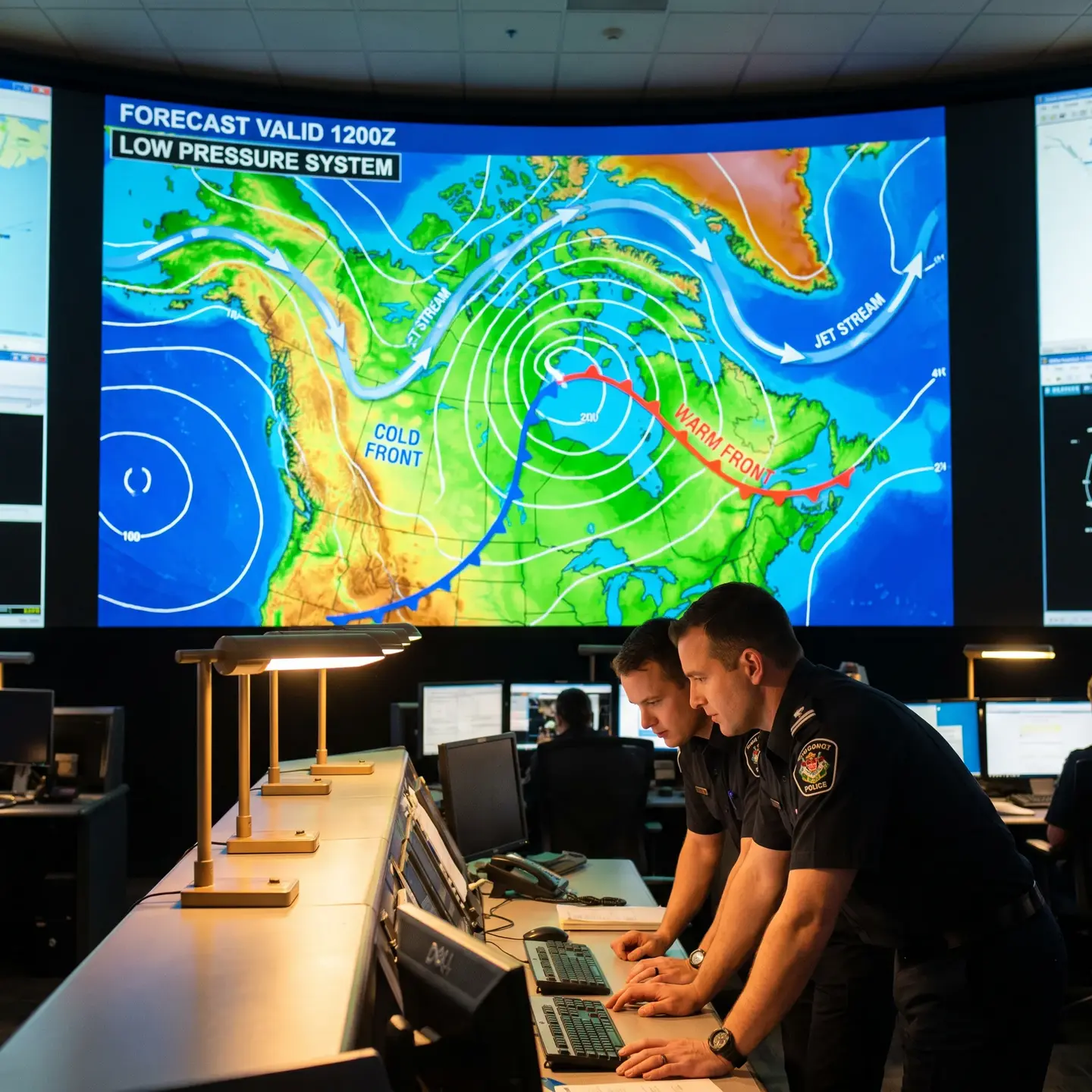
The study guide addresses frontal jet streams, subtropical jet streams, low-level nocturnal jet streams, seasonal variations, and the distribution of wind, temperature, and turbulence at altitude. Jet streams are fast-flowing currents of air near the tropopause, typically associated with strong horizontal temperature gradients.
Operational Relevance
For ATPL operations, jet streams affect:
- Groundspeed and fuel burn — Headwinds increase fuel consumption and flight time; tailwinds reduce them.
- Altitude selection — Choosing flight levels that optimize wind advantage while avoiding severe turbulence.
- Turbulence risk — CAT is often found in zones of strong wind shear near jet cores, particularly at the boundaries where aircraft transition rapidly between different wind velocities.
The polar front jet stream is particularly relevant for flights across Canada, influencing route planning and altitude decisions on transcontinental operations.
Air Masses, Fronts, and Frontal Weather
Air mass formation, classification, modification, fronts, frontal cross-sections, frontal waves, occlusions, TROWALs, upper fronts, and frontal weather are all included in the TP 690E topics. These concepts help pilots anticipate changes in cloud, precipitation, visibility, turbulence, icing, and wind as weather systems move across their planned routes.
Frontal Systems
Canada is influenced by several air mass types, including continental Arctic, continental polar, maritime polar, and maritime tropical. The interaction of these air masses along fronts produces characteristic weather patterns:
- Cold fronts — Often produce narrow bands of intense weather, including thunderstorms, heavy precipitation, and turbulence.
- Warm fronts — Typically bring extensive cloud layers, prolonged precipitation, and significant icing potential, especially in winter.
- Occluded fronts — Combine characteristics of both cold and warm fronts, often with complex weather patterns.
- TROWALs (Troughs of Warm Air Aloft) — A Canadian-specific concept describing warm air trapped aloft during an occlusion, producing extended periods of precipitation and icing.
Understanding frontal structure and movement allows pilots to anticipate when and where hazardous weather will affect their route, altitude, and alternate options.
Aircraft Icing
The study guide dedicates significant attention to icing formation, ice types, cloud types and icing, freezing rain and drizzle, collection efficiency, aerodynamic heating, and reporting criteria. Icing is one of the most operationally significant weather hazards for Canadian pilots.
Icing Formation Requirements
Structural icing requires two conditions:
- Visible moisture (cloud droplets, rain, or drizzle)
- Ambient temperatures at or below 0°C
Ice Types and Hazards
- Clear ice — Forms from large supercooled droplets that spread and freeze slowly, producing smooth, transparent, and difficult-to-remove ice.
- Rime ice — Forms from small droplets that freeze rapidly on contact, producing opaque, rough deposits.
- Mixed ice — A combination of clear and rime characteristics.
Aircraft icing degrades lift, increases drag, raises stall speed, affects handling characteristics, and can impair engine operation, instruments, and sensors. Freezing rain and freezing drizzle are particularly hazardous because they can produce rapid ice accumulation that exceeds the capability of aircraft ice protection systems.
The TC AIM emphasizes that pilots of aircraft without certified ice protection should avoid planned flight into known or forecast icing conditions. Even aircraft with ice protection have limitations, and minimizing exposure remains the safest strategy.
Thunderstorms
Thunderstorm requirements, life cycle, classification, and hazards are addressed in the study guide. For ATPL candidates, thunderstorms represent one of the most significant operational hazards requiring active avoidance.
Thunderstorm Hazards
Thunderstorms can produce:
- Severe turbulence
- Hail
- Heavy precipitation
- Lightning
- Gust fronts
- Downbursts and microbursts
- Low-level wind shear
These hazards affect route planning, approach timing, takeoff and landing decisions, and diversion planning. The presence of thunderstorms along a route or at a destination requires careful assessment of whether the flight can be conducted safely or whether delays, reroutes, or diversions are necessary.
Microbursts are particularly dangerous because they produce intense, localized downdrafts and wind shear that can exceed aircraft performance capabilities during critical phases of flight. Modern training emphasizes recognition and escape procedures, but avoidance remains the primary defence.
Surface-Based Layers and Visibility Restrictions
Fog, haze, smoke, and blowing obstructions to vision are included in the study guide. These phenomena directly affect visibility, takeoff and landing decisions, and alternate planning.
Fog Types
Different fog types have different formation mechanisms and persistence:
- Radiation fog — Forms overnight under clear skies and light winds, often dissipating after sunrise.
- Advection fog — Forms when warm, moist air moves over a cold surface, and can persist throughout the day.
- Upslope fog — Forms when moist air is lifted along rising terrain.
- Frontal fog — Associated with frontal precipitation, particularly warm fronts.
- Ice fog — Forms at very cold temperatures when water vapour sublimates directly into ice crystals.
Understanding fog type helps pilots predict when conditions will improve and whether alternate planning should account for extended periods of low visibility.
Meteorological Services, Reports, Forecasts, and Charts
The study guide covers meteorological services available to pilots, aviation weather reports, forecasts, weather maps, and prognostic charts. The TC AIM Meteorology section provides detailed guidance on how these products are structured and used operationally.
Weather Services and Briefings
- Flight Information Centre (FIC) briefings — Interpretive briefings combining meteorological and aeronautical information.
- ATIS — Automated airport information including current weather.
- VOLMET — Continuous weather broadcast for selected airports.
- AWOS and LWIS — Automated observation systems providing current conditions.
Weather Reports
- METAR — Routine hourly weather observations.
- SPECI — Special reports issued when significant changes occur.
- PIREP — Pilot reports of actual conditions encountered in flight.
Forecasts
- TAF — Aerodrome forecasts covering expected conditions.
- GFA (Graphical Area Forecast) — Regional graphical forecasts depicting clouds, weather, icing, turbulence, and freezing levels.
- AIRMET — Advisory of the occurrence or expected occurrence of weather phenomena, which may affect the safety of aircraft operations
- SIGMET — Advisory of the occurrence or expected occurrence of specified weather phenomena, which may affect the safety of aircraft operations.
- Upper-level wind and temperature forecasts — Forecast winds and temperatures at specified flight levels.
Charts
- Surface analysis charts — Current positions of pressure systems, fronts, and surface weather.
- Prognostic surface charts — Forecast positions of pressure systems and fronts.
- Upper-level charts — Winds, temperatures, and features at altitude.
- Significant weather prognostic charts — Forecast areas of significant weather including turbulence, icing, and convective activity.
Integrating Weather Products
At the ATPL level, effective weather assessment means combining multiple products rather than reading them in isolation. A pre-flight weather briefing integrates METARs and TAFs for departure, destination, and alternates; GFAs for enroute conditions; upper winds for fuel and time calculations; PIREPs for actual conditions; and SIGMETs or AIRMETs for hazardous weather. In flight, this assessment continues through ATC advisories, updated reports, and pilot reports from other aircraft.
The ability to synthesize weather information and adjust plans accordingly—whether by delaying departure, selecting different altitudes, choosing alternate routes, or diverting—defines the operational competence expected of ATPL holders.

Conclusion
Advanced meteorology at the ATPL level means anticipating and managing weather risks through the synthesis of forecasts, observations, and system-level understanding. This is not about passing a multiple-choice examination through memorization—it is about developing the judgment and analytical skills that support the decision-making process, crew coordination, and the safe conduct of commercial operations. The topics outlined in TP 690E represent the meteorological knowledge Transport Canada expects of pilots holding the Airline Transport Pilot Licence, and mastering this material prepares you for both the SAMRA examination and the operational realities of professional flying in Canadian airspace.
Frequently Asked Questions
Why do we need to apply cold-temperature corrections?
ISA gives us the baseline for performance, altimetry, and planning, but Canadian winters routinely break that model. When temperatures drop well below ISA, we know pressure levels are compressed and our true altitude sits lower than indicated. Operationally, we must apply cold-temperature corrections to IFR minima and step-down fixes, especially in mountainous terrain, or we risk eroding our obstacle clearance margins.
How should we deal with icing and thunderstorms when planning an IFR flight?
In Canadian IFR operations, structural icing and convective weather are two of the few items that can rapidly outpace aircraft capability and crew skill. We respect them as hard constraints, not challenges to “work through.” For icing, we plan to avoid known or forecast severe conditions and minimize exposure even with protection systems. For thunderstorms, we plan and brief to avoid, not penetrate—using radar, routing, and timing to keep the aircraft out of convective cores and microburst environments.
How should we practically integrate all the weather data for planning?
We approach weather data the way we’d fly an IFR profile: in sequence and with cross-checks. METARs and TAFs anchor departure, destination, and alternates; GFAs and significant weather charts outline the enroute “big picture”; upper winds drive our fuel, time, and altitude strategy; SIGMETs and AIRMETs define no-go or caution areas. We then refine that picture with PIREPs and in-flight updates, adjusting tracks, levels, or alternates just as we would adjust a flight path off raw data in IMC.